
When Product Pages Start "Talking": Practical Observations on Using AI to Transform Static Information into Sustained Traffic
In the SaaS world, we often talk about “product-led growth,” but many times, our own product pages fall silent. They just lie there, waiting to be searched and discovered. In 2026, the content ecosystem has fundamentally changed: users are no longer satisfied with a feature list; they need guides, scenarios, comparisons, and stories. The problem is, team bandwidth is always limited, making it impossible to write countless blog posts for every feature and every product variation. This contradiction is particularly sharp in SaaS businesses that need to cover global multilingual markets.
The Chasm from “Instruction Manual” to “Buying Guide”
What does a typical SaaS product page contain? A feature list, pricing table, customer testimonials, perhaps a demo video. This information is necessary, but it’s also “passive.” It answers “what it is,” but rarely proactively answers “why I need it,” “how it solves my specific problem,” or “how it’s better than X.” These are precisely what users search for on Google, and they are key to conversion.
In the past, our approach was to build content teams to manually break down core products into different themes: buying guides, tutorials, comparison reviews, and scenario-based case studies. This was effective, but extremely slow and difficult to scale. A deep buying guide could take days to research, write, optimize, and publish. When we have dozens of products and need to cover multiple markets like English, Spanish, and Japanese, this task becomes almost impossible. We were caught in a dilemma: either content output couldn’t keep up with product iteration, or content quality was poor and couldn’t drive conversions.
A Failed Experiment and a Crucial Turning Point
We once tried to use general AI writing tools to batch-generate content. We’d input product descriptions and ask it to write a blog post on “Why You Need XX Product.” The result? The articles were fluent and grammatically correct, but they read like polished press releases, filled with empty praise and vague generalities. They lacked specific, verifiable factual details and couldn’t answer users’ real concerns. More importantly, they were clueless about SEO, generating keywords that were either highly competitive or had no search volume.
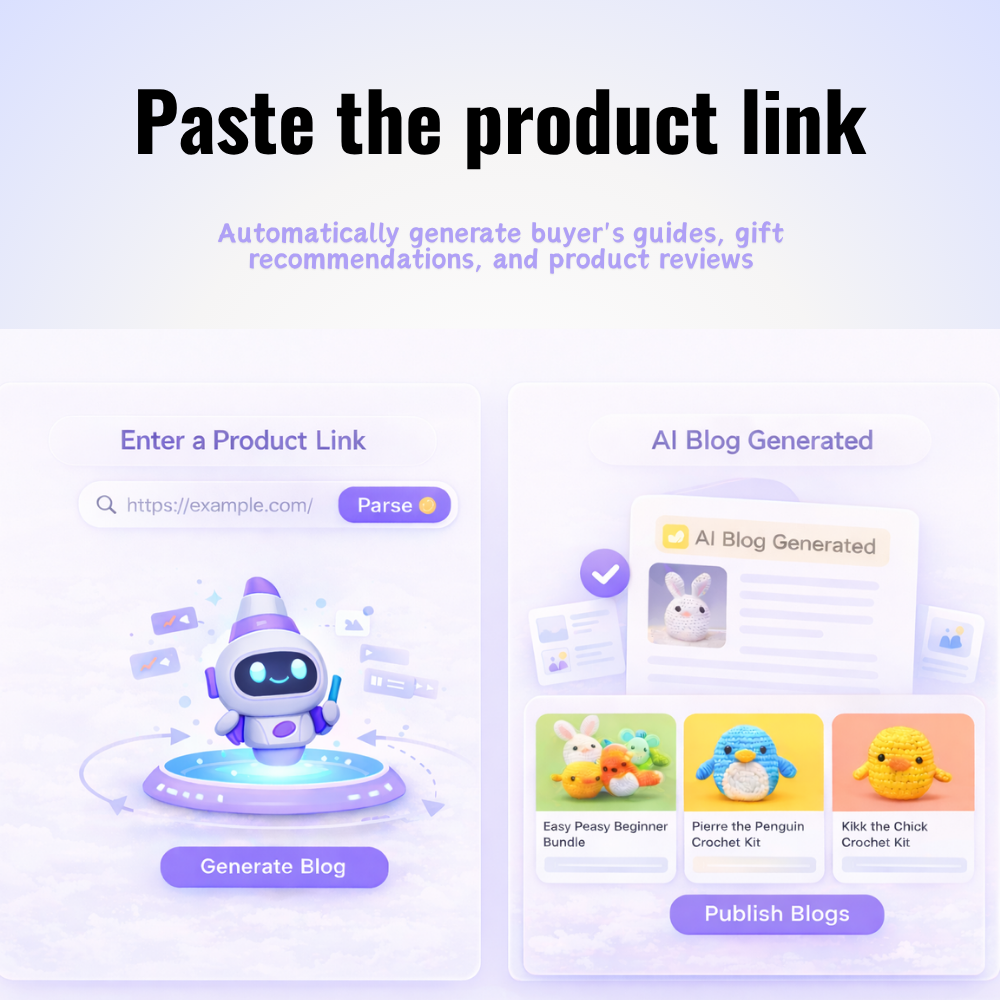
The real turning point came when we started thinking about “information sources” and “fact anchors.” What we needed wasn’t “creation” from scratch, but “transformation” and “extension” based on existing, accurate product information. It was then that we started using SEONIB. Its “Product to Blog” feature offered a completely different approach: you don’t need to describe the product from scratch; just input the product page link.
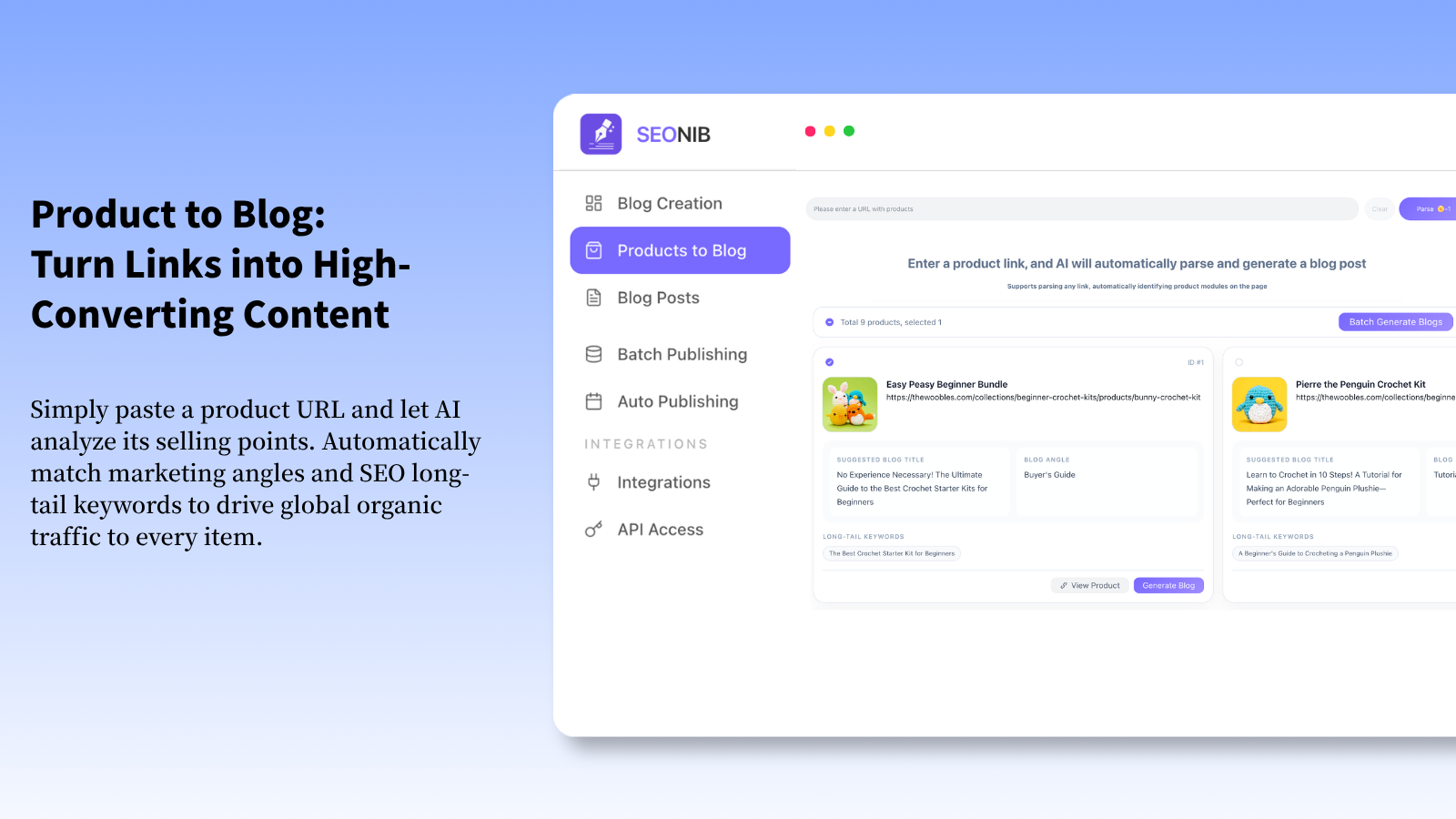
The system, like the most patient intern, automatically parses all the information on the page—feature highlights, technical specifications, use cases, even implied advantages. Then, instead of simply repeating it, it uses this as an unshakeable knowledge base (RAG) to build content around it. For example, it might extract a product detail like “crocheting with multiple hooks is difficult” and automatically generate a tutorial blog titled “Why Is Crocheting Dolls with Multiple Hooks Difficult? Understand in 10 Minutes, Even Beginners Can Easily Get Started.” The material for this article comes entirely from the product itself, but the angle is language that users would search for.
How Does Static Information Come “Alive”?
What’s most fascinating about this process is the dynamic handling of “static information.” SEONIB’s AI performs several key actions:
- Long-Tail Keyword Extraction and Scenario Building: It doesn’t just focus on broad terms like “crochet kit” but digs into product information to uncover specific scenarios and problems like “beginner crochet starter” or “doll shaping and creation.” These are what real users search for with purchase intent.
- Information Reorganization and Narrative Transformation: The information structure on a product page is for display, while a blog’s structure is for persuasion and answering questions. The AI transforms technical specifications into descriptions of solutions to user pain points and weaves feature lists into a step-by-step “buyer’s journey.”
- Automatic Derivation of Multiple Content Types: From the same product link, it can simultaneously generate various formats like buying guides, in-depth tutorials, and comparison reviews (if competitor data is available in the knowledge base). This is equivalent to using one input to leverage multiple search engine traffic entry points.
We tested this process on a SaaS tool plugin for crafters. Previously, its sales relied mainly on in-platform traffic. After inputting the product link, the system automatically generated 5 blog posts from different angles: a guide for absolute beginners titled “Zero-Code Creation of Digital Stores,” a comparative analysis for users migrating from other platforms, a scenario-based article on “How to Enhance Your Work Display with This Plugin,” and two short articles answering specific technical questions.
After publishing to related blogs, we observed a 300% increase in traffic from Google searches within four weeks. Most of this traffic went directly to specific feature points on the product page, with a conversion rate 70% higher than general traffic. This validated a hypothesis: content that “grows” from the product information itself has the highest product fit and brings users with the clearest intent.
Beyond Automation: Precision, Brand, and Ecosystem
Of course, this isn’t a magic bullet that works with one click. RAG-based generation ensures factual accuracy and avoids AI fabrication, but the brand tone and narrative depth of the initial draft may still require manual fine-tuning. AI excels at expansion and reorganization, while humans excel at injecting emotion and strategic perspective.
Another observation is that this “product-to-content” model is best suited for products with a clear information structure and a well-defined value proposition. If the product page itself is chaotic, the generated content will only be an amplified version of that chaos. This, in turn, forces optimization of the product page itself.
From a broader operational perspective, this opens up a new content strategy: treating every product page as a “root directory” that can automatically spawn countless content nodes. Content is no longer an expensive one-off project but an automatable, sustainable byproduct of the product launch process. It liberates content teams from being repetitive information movers to becoming strategy setters and brand storytellers.
In 2026, competition may no longer be solely about whose product features are more powerful, but about whose product information can “speak” more intelligently and continuously, proactively waiting at every path where users seek answers. Transforming static information into dynamic traffic may no longer be a “high-level play” in content marketing, but has become a fundamental capability for SaaS survival.
FAQ
Q: Will automatically generated content be deemed low-quality or duplicate content by search engines? A: Based on our experience, the key lies in the generation logic. Simply restating product page information does carry risks. However, tools like SEONIB, with their core RAG (Retrieval-Augmented Generation) and long-tail scenario derivation, generate interpretations, answers, and contextual extensions of the original information, creating new, valuable search pages rather than duplicates. Search engines index new content, and as long as the content effectively addresses search intent, rankings and traffic will be natural.
Q: Is this suitable for all product types? A: It is most suitable for SaaS tools, software, hardware, or complex consumer goods with high information density, clear feature points, and where user decisions require a certain level of information support. For products where brand value relies heavily on emotional narrative, or for simple fast-moving consumer goods, the effect may be limited. Its strength lies in “explanation” and “guidance.”
Q: How is accuracy ensured when generating multilingual content? A: The accuracy of multilingual generation depends on two levels: first, the accuracy of parsing the original product information (usually in English), and second, the appropriateness of the translated and localized expression. In our tests, the factual parts (specifications, features) based on RAG have high accuracy, but the localization of marketing language and culture may still require manual review and fine-tuning, especially in markets like East Asia.
Q: How is the ROI of such content measured? A: The most direct metrics are the click-through rates from these blog pages to the product pages, and the actual registrations or purchases driven by this traffic. Compared to general traffic, the conversion rate of this type of content is typically an order of magnitude higher. Secondly, one can observe the growth in rankings for brand-related long-tail keywords.
Q: Will this make content creators unemployed? A: Quite the opposite; it changes the role of creators. They will be freed from tedious information gathering and basic writing to focus more on content strategy planning, brand storytelling, content optimization, and user interaction. Machines are responsible for “scaling the production of accurate information,” while humans are responsible for “injecting soul and strategy.” This is a collaboration, not a replacement.