
The "Alchemy Furnace" and "Photocopier" of SEO Content Creation: Why Are We Still Producing Internet Garbage?
After working in SaaS content marketing for several years, I’ve gradually noticed an interesting phenomenon: everyone seems to be playing two games. One is “alchemy,” where teams shut themselves away, using various complex formulas, the latest algorithms, and expensive tools to try and concoct a “magic elixir” that can explode traffic. The other is “copying,” where they find a well-performing competitor article, copy and paste, give it a facelift, and then pray that the search engine’s plagiarism checker is taking a nap today.
The result? The former is costly and produces unstable output, much like medieval alchemy; the latter is fraught with risk, ranging from being penalized by algorithms to receiving cease and desist letters from infringement lawyers. Even worse, regardless of the method, the content produced is often homogenized internet noise, leaving users questioning their life choices after reading the third article: “Why are they all saying the same old thing?”
Where does the problem lie? We misunderstand the essence of “reference” and “rewriting.”
The “Depth” Trap of Competitor Analysis: What You See Is Just the Tip of the Iceberg
When many teams come across an excellent competitor article, their first reaction is to deconstruct its structure, extract its key points, and replace its examples. This is not wrong, but it’s too superficial. An article that can consistently rank in search results and drive conversions has value far beyond its surface-level text. What is its underlying logic?
- The “Asymmetry” of Keyword Placement: You might see the main keyword, but how does it use semantically related long-tail keywords, question formats (PAA), and LSI keywords to build a “topic cloud” that search engines can easily understand?
- The “Layered Satisfaction” of User Intent: The article might simultaneously serve informational, commercial investigation, and transactional search intents. How does it use its chapter arrangement to gradually guide visitors who “just want to know a little” towards “where can I buy”?
- The “Implicit Signal” of Content Freshness: Beyond the publication date, does the article cite the latest industry reports, statistical data, or news events? These are crucial for maintaining ranking vitality but are also the details most easily overlooked by “rewriters.”
I once led a team to do this manually. It took a senior editor at least half a day to analyze a 3000-word in-depth article. The conclusion was a beautifully crafted mind map, but its execution still relied on the writer’s subjective understanding and expression skills, leading to significant quality fluctuations. What we need is not a faster “photocopier,” but a system that can understand the DNA of content and “cultivate” new organisms based on it.
From “Article Spinning” to “Benchmarking”: When AI Begins to Understand Content Structure and Soul
The turning point came when we attempted to systematize this process. The inefficiency and subjectivity of manual analysis forced us to seek tools, and that’s when we encountered SEONIB. Initially, we saw it merely as a bulk generation tool, but its “reference link original rewrite” feature changed our approach.
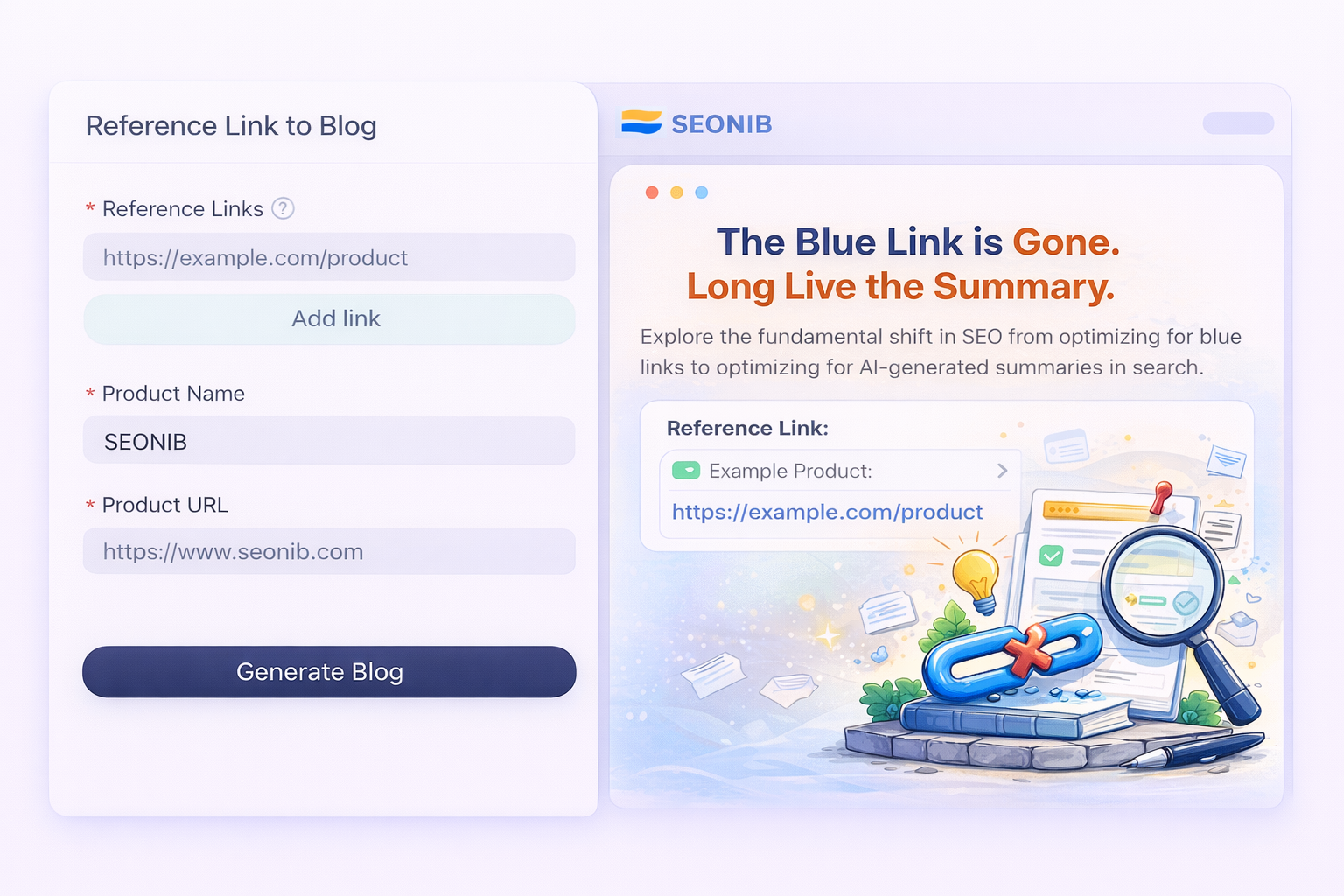
Its working method is quite interesting: you input the competitor article link, and it doesn’t simply extract text and rewrite it. Based on our observations, it’s more like performing a deep “surgical” analysis:
- Structural Deconstruction: It automatically identifies the article’s core arguments, sub-points, logical flow, and supporting examples, understanding its skeleton.
- Intent Analysis: It determines which specific user problem or intent each section addresses.
- Point Extraction: It strips away factual information (which can be retained) and original opinions/conclusions (which need to be reconstructed).
- Multi-dimensional Reconstruction: Based on the original topic and keywords, it accesses a broader database and language model to reassemble a new article with the same (or even stronger) SEO effectiveness and informational value, using different logical paths, updated examples, and differentiated phrasing.
For instance, we once used a viral article from a well-known project management software company about “pain points of remote team collaboration” as a reference. The new article generated by SEONIB had the same core pain points (asynchronous communication, tool clutter, lack of transparency in progress) – this is market consensus. However, the approach to solutions differed: the original article focused on recommending tool features, while the new one delved into process aspects like “establishing team communication protocols” and “designing asynchronous workflows,” citing updated remote work survey data. The result? The new article quickly surpassed the original in rankings for several less competitive long-tail keywords.
This is no longer plagiarism, but “high-quality benchmarking” based on the same market truth, presented from different perspectives. The cost? The generation cost for a single in-depth long article is as low as $0.199, and it uses a credit system rather than subscriptions, so you buy what you use, and credits never expire. This flexibility and cost-effectiveness are crucial for content testing and scaled production.
Zero-Cost Launch and “Instant Gratification”: Breaking the Final Psychological Barrier to Content Launch
The biggest loss in content marketing often isn’t in production, but in “hesitation to launch.” The article is written, but then there’s configuring the website CMS, designing the layout, worrying that the domain authority isn’t enough for it to be effective… a pile of trivial matters that can be daunting, leading many good drafts to languish in the backend.
This is another underestimated value of SEONIB: it provides a complete “publishing sandbox.” New users receive 8 free credits upon registration, enough to generate 8 in-depth articles for a full workflow trial. More importantly, the platform offers a free temporary preview domain for each content project.
What does this mean? You can:
- Generate a benchmarked article using a competitor’s link.
- Publish it with one click to the temporary domain provided by the platform.
- Within minutes, see a complete blog post with a clean layout that is publicly accessible.
- Directly submit this link to the search engine’s URL inspection tool to monitor indexing status; or share it with your team for direct feedback.
This “zero-barrier launch” loop significantly shortens the path from “I have an idea” to “content is live and being tested.” It solves not only technical problems but also psychological ones – making content publishing as simple as sending a message, removing the final obstacle before action. Our team used this feature to quickly test five different content directions within a week, and through preliminary access data from preview links and simple SEO queries, we rapidly identified two of the most promising avenues, avoiding blind investment of significant resources.
Final Thoughts: Tools Liberate Manpower, But Strategy Still Requires the Human Brain

After using tools like SEONIB for nearly a year, my biggest takeaway is this: it perfectly handles the most time-consuming, repetitive, and scalable “middle stages” of content production – namely, in-depth analysis, structured restructuring, and multilingual adaptation. This liberates our content team from the role of “content laborers,” allowing them to refocus their energy on tasks that only humans can do well:
- Strategy Development: Who should we benchmark against? Which niche market should we choose? How should the content matrix be laid out?
- Deep Creativity: What are the pioneering insights that AI cannot replace, truly possessing industry foresight?
- Emotional Connection: How can we inject the brand’s unique tone and values into formatted articles?
- Performance Analysis and Iteration: Based on the data from tool-generated content, how do we adjust the direction for the next phase?
In the future, successful content teams may no longer be “writing teams,” but “content strategy and AI trainer teams.” Our core competency will shift from “writing well ourselves” to “knowing why and how to have AI write, and how to judge whether it’s written well.” This process is far more complex and interesting than simply “translating” an article from Chinese to English.
FAQ
Q1: Is rewriting competitor articles using AI considered plagiarism? Will it be penalized by search engines? A: This depends on the depth of the rewrite. Simple synonym replacement and sentence reordering are dangerous forms of “article spinning.” However, deep analysis and opinion reconstruction, as performed by tools like SEONIB, produce content based on the same factual information but with independent logical expression and added value. Search engines penalize low-quality, repetitive, and valueless content, not all articles discussing the same topic. The core is whether the new content offers a unique perspective, updated information, or a better organizational structure.
Q2: At $0.199 per article, can the quality be guaranteed? Won’t it be superficial? A: The low price stems from technology-driven economies of scale, not a compromise on quality. The key lies in the tool’s “analyze-reconstruct” capability. Based on experience, the articles it produces far exceed the passing line as a foundation for SEO content in terms of structural completeness, keyword coverage, and readability. However, it remains a “foundation” that requires human review and refinement in terms of core opinion sharpness, brand voice integration, and supplementation with the latest examples to reach an “excellent” standard.
Q3: How long can the 8 articles generated with the registration credits be used? A: The credits are valid permanently, with no time limit. You can use these 8 articles immediately or test them gradually. This is very user-friendly for those who want to experience the entire workflow (from competitor analysis, generation, to previewing the launch) at zero cost, with no trial period pressure.
Q4: Is the free temporary domain preview meaningful for practical SEO? It’s not my main site, after all. A: It’s highly meaningful, primarily in the “validation” and “decision-making” stages. 1) Indexing Verification: You can test whether search engines will quickly index this new content and understand the current algorithm’s friendliness. 2) Preview Effectiveness: You can visually see the final form and reading experience of the article after publication, facilitating internal team review. 3) Rapid Trial and Error: Before publishing on your main site, you can test user preliminary feedback for different content directions at a low cost (e.g., by obtaining click data from shared links). While it won’t directly contribute to your main site’s authority, it significantly reduces decision-making risks before official launch.
Q5: Is it suitable for complete beginners who don’t understand SEO? A: It’s very suitable as an introductory and launch tool. Its automated processes (analyzing trends, generating SEO articles, one-click publishing) abstract away most complex operations. Beginners can bypass initially confusing steps like “learning keyword research, TDK settings, internal linking,” and directly see the complete cycle of “producing content - getting traffic,” establishing the most intuitive understanding. On this foundation, delving deeper into SEO principles will be more directed and motivating.