
From Video Traffic to Search Weight: How One Piece of Content Drives Multi-Platform Content Reuse
Before 2025, many SaaS teams focused their content strategy on video platforms. YouTube tutorials, TikTok quick demos, LinkedIn industry insights – these indeed generated substantial viewership and engagement. However, by 2026, a growing problem emerged: while video traffic was immediate, it was as transient as flowing water, difficult to retain. Users watched and left, brand recognition remained superficial, and search engine ranking saw almost no growth. Even more frustrating was the considerable cost of video production. Scripting, filming, editing, publishing – a comprehensive process that consumed significant team resources yet struggled to build sustainable assets.
We had a typical case: an API tool for developers had YouTube feature demonstration videos with an average viewership exceeding 50,000, yet the corresponding technical articles on the official website blog received less than 500 monthly visits. Video viewers were not converting into search users. When they searched for specific technical issues on Google, they often found in-depth articles from competitors. The bustling activity of video contrasted sharply with the quietness of search. This made us realize that if video traffic isn’t effectively “settled” into searchable, accumulable text content, its long-term value is significantly diminished.
The “Traffic Trap” of Video Content and Search Blind Spots
Video platform algorithms prioritize watch time and engagement rates, which fundamentally differ from the core logic of search engines – solving users’ explicit search intent. A 60-second quick-operation video that goes viral on TikTok might spread due to music, rhythm, or visual impact. However, the core knowledge points within the video (e.g., “How to configure automated abandoned cart recovery emails for a Shopify store”) cannot be crawled and indexed by Google because they lack a text medium.
A more practical operational challenge is that teams often lack the bandwidth to manually convert every video segment into a well-structured, keyword-optimized long-form article. Common practices include attaching a brief text description or repurposing video subtitles, but these fall far short of SEO article standards. Subtitles are typically colloquial, repetitive, and lack logical structure. Publishing them directly results in a poor reading experience, and search engines struggle to understand the core themes and hierarchical relationships. We once tested pasting the subtitles of a 15-minute interview video directly into a blog post. The “Coverage” status in Google Search Console remained “Crawled, currently not indexed” for a long time, indicating that the search engine clearly did not consider it “qualified” content worthy of inclusion.
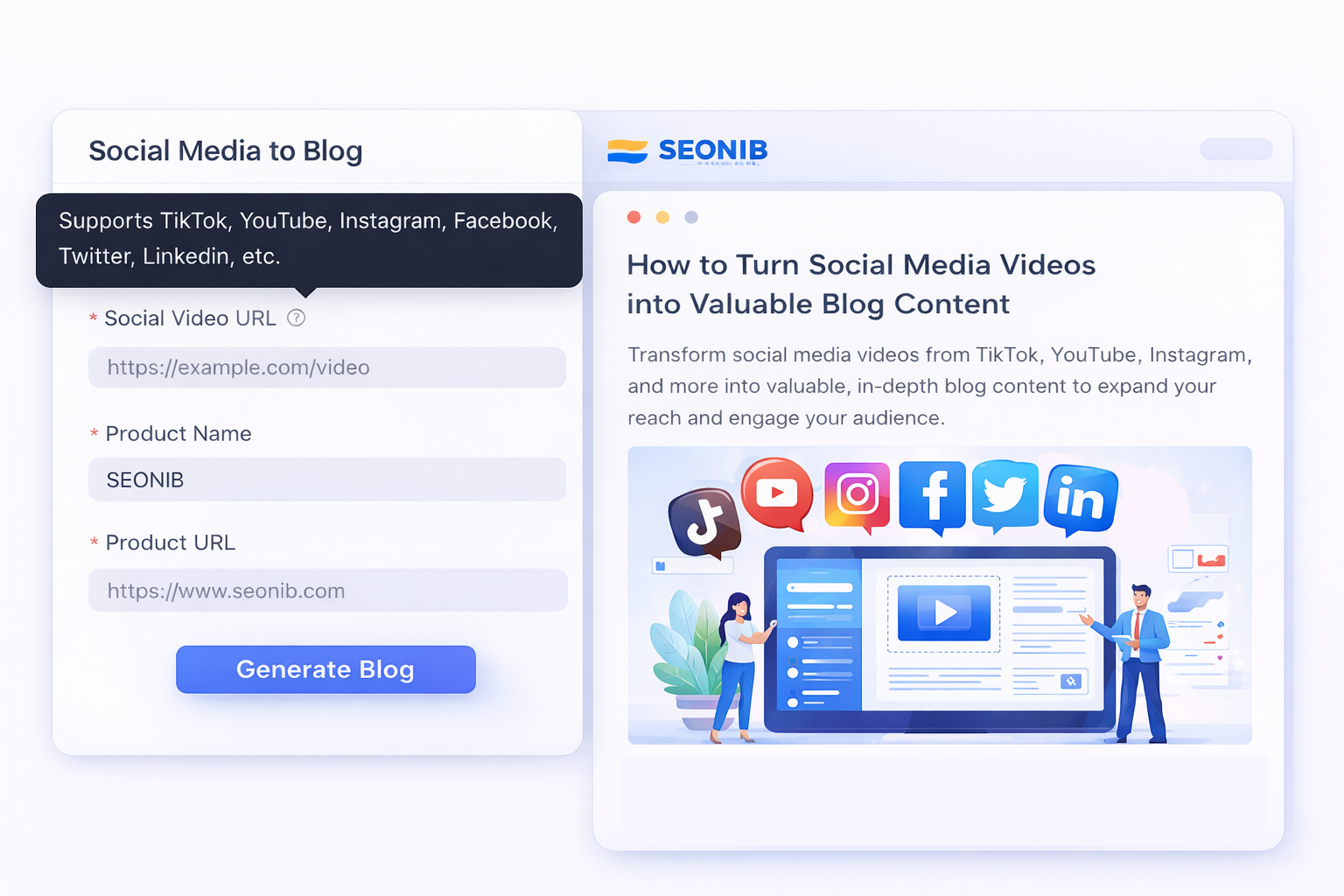
Reconstruction, Not Transcription: Transforming Video Insights into Search Assets
The key is not to turn videos into text, but to extract the insights, processes, and solutions from videos and reorganize them into a format that aligns with the reading and retrieval habits of search users. This requires several leaps:
- From Spoken to Written Language: Videos often contain numerous filler words, repetitive emphasis, and improvisations. Good text needs to eliminate these and retain concise arguments.
- From Linear to Structured Reorganization: Videos are linear in time, with viewers following the presenter’s pace. Articles, however, need clear H2/H3 headings, paragraph divisions, and lists to allow readers (and crawlers) to quickly locate information.
- From Demonstration to Descriptive Supplementation: Demonstrations like “click here, then drag that component” in a video need to be translated into precise terminology and contextual explanations in an article, as readers cannot see the visuals.
- Integration and Expansion of Intent Keywords: Video titles might be designed for clickability, but article titles and content need to revolve around users’ actual search queries and naturally incorporate long-tail keywords.
In the past, this process heavily relied on the subjective understanding and writing skills of content operations personnel, consuming significant time and effort. It wasn’t until a large-scale content experiment that we systematically introduced SEONIB as the “reconstruction engine” in our workflow. Its value lies not in replacing video creation, but in bridging the vast gap between “video publishing” and “search asset establishment.”
One Piece of Content, Multiple Returns: The Path of Traffic Reuse in Practice

Our Standard Operating Procedure (SOP) became clear:
- Core Asset Production: The team continues to focus on producing high-quality explanatory videos, publishing them on YouTube or LinkedIn. This serves as the first entry point for traffic and brand display.
- Link Extraction and Parsing: Input the video link into SEONIB. The system automatically extracts subtitles, but this is just the first step. More importantly, its AI analyzes the subtitle text, identifies core arguments, step-by-step processes, pain point solutions, and understands the overall knowledge framework of the video.
- Professional Long-Form Article Generation: Based on the parsing results, SEONIB generates a draft of a complete blog post. It doesn’t just organize subtitles; it creates a full article framework including an introduction, logical subheadings, step-by-step breakdowns, key takeaways, and even an FAQ section. We compared it: manually rewriting a LinkedIn video about a “SaaS Customer Retention Analysis Model” took 4-5 hours. SEONIB’s draft, generated in minutes, already provided a usable foundation in terms of logical completeness, requiring only about 30 minutes of industry terminology calibration and case refinement before publication.
- Multi-Platform Adaptation and Publishing: The generated article can be published with one click to our main WordPress blog, which is central to building search authority. Simultaneously, key excerpts from the article can be repurposed as image-text posts for LinkedIn and Facebook, attracting another professional audience. Key lists and conclusions can be turned into infographics for Instagram and Twitter. In this way, the value of a single video asset is extracted multiple times and in multiple formats.
Cost-effectiveness is decisive. For startups and small to medium-sized SaaS teams, content budgets are always tight. SEONIB’s credit-based system (as low as $0.199/article) instead of a subscription model feels very flexible. We don’t have to pay for monthly quotas we might not use; we only consume credits when we have video assets to convert. Furthermore, credits are permanent, reducing our decision-making costs and inventory pressure. During the testing period, we converted over 20 accumulated core tutorial videos into blog posts at a cost of less than $50. More than 60% of these received organic search traffic from Google within two months of publication.
Unexpected Gains and Boundaries to Note
This strategy brought more than just search traffic. We found that articles converted from videos often had longer user dwell times and higher page interaction rates than purely text-based blog posts. We hypothesize this is because the articles originate from authentic, enthusiastic video content, making the knowledge transfer more natural and engaging. Simultaneously, the blog posts, in turn, provide detailed textual annotations and links for further reading to the videos, forming a content loop and enhancing overall professionalism.
However, this process is not fully automated magic. The quality of AI reconstruction highly depends on the clarity and information density of the original video content. A rambling, loosely argued video is difficult to distill into a well-structured article. Therefore, upfront planning of video scripts becomes more important than ever – we need to consciously organize our arguments during recording, which in turn improves the quality of our video content.
Additionally, the generated article drafts must be reviewed by operations personnel familiar with the domain. AI may not understand extremely specialized industry jargon or newly emerging technical acronyms, nor may it grasp context implied visually but not explicitly stated in the video. The human role shifts from “writer” to “editor and calibrator,” which also requires time and professional judgment.
Outlook: The Symbiotic Relationship Between Video and Search
Entering 2026, the era of solely chasing video traffic is passing, while the value of search traffic, due to its clear intent and long-term stability, is becoming increasingly prominent. The most effective content strategy is no longer a choice between “making videos or writing blog posts,” but rather how to make them collaborate efficiently to achieve asset reuse. Using video as a hook for cutting-edge insights and traffic attraction, while simultaneously using intelligent tools to quickly consolidate it into searchable, in-depth text, is becoming a standard configuration for many SaaS teams’ content operations. This is not just for SEO, but for building a three-dimensional, sustainable content system capable of engaging users across platforms. In this process, tools like SEONIB play not the leading role, but a crucial backend “converter,” significantly lowering the barrier and cost of transitioning from one media asset to another, enabling smaller teams to practice the “omnichannel content reuse” strategies previously only accessible to large corporations.
FAQ
Q: Can I just paste video subtitles into a blog post and make minor edits? A: We tried this early on with poor results. Colloquial subtitles are repetitive, logically jumpy, and lack terminology, making them difficult to read. Search engines struggle to identify clear themes and content value, leading to pages not being indexed or ranking very low. The core of reconstruction is reorganizing written content based on the video’s “knowledge logic,” not transcribing text.
Q: Is this solution suitable for all types of videos? A: It is most suitable for tutorials, product demonstrations, industry analyses, and in-depth interviews – videos with high information density and clear logical lines. Purely entertainment, narrative, or overly casual daily sharing videos will have significantly reduced conversion effectiveness due to a lack of extractable structured information, and may even generate meaningless articles.
Q: Will the generated articles be flagged by search engines as low-quality or duplicate content? A: The key is “reconstruction,” not “copying.” If a tool simply rearranges subtitles, there is indeed a risk. However, good tools (like SEONIB) generate entirely new article expressions based on semantic understanding and structure information logically. As long as the generated content offers a unique, complete perspective and has been reviewed and polished by humans, it will not be considered low-quality or plagiarized. In our practice, the vast majority of articles have been indexed normally.
Q: Besides blogs, how else can this generated content be used? A: This is where the reuse value lies. The generated long-form articles are the core assets. You can extract key phrases for social media image posts, distill steps into Twitter threads, turn key lists into Instagram infographics, or even re-record main points as scripts for short videos. One investment yields multiple content assets.
Q: What are the advantages of a credit system compared to a subscription model? A: It is particularly friendly to small and medium-sized teams with irregular content output. You don’t have to pay a fixed monthly fee during off-peak traffic seasons or project lulls. Use credits when you have video assets to process, and pause when you don’t, leading to efficient fund utilization. The permanent validity of credits also avoids the behavior of “using up quotas before the end of the month,” allowing for more relaxed content planning.