
In 2026, How My Cross-Border Content Site Survived with a "Frugal" Tool Combination
It’s that time of year again for year-end reviews. Looking at the organic traffic curve in the backend, which started near zero at the beginning of the year and has been steadily climbing towards the end, feels like watching a mini startup documentary. The protagonist isn’t me, but my “frugal” tool combination, pieced together bit by bit after being beaten down by reality. In 2026, running a content site, especially one targeting a global audience, is long past the era of burning cash to buy traffic. The core challenge has become: how to continuously produce content that search engines and real users appreciate within a limited budget, without burning yourself out.
Many imagine that with AI tools, content will flow like tap water. The reality is, you’ll first get a pile of grammatically correct but soulless “text corpses,” along with a monthly subscription bill that makes your heart skip a beat. Our first lesson learned: beware of the silent costs of “subscription models.” When you keep paying for a bunch of tools because you think “I might need them next month,” the psychological pressure is more agonizing than not being able to write an article.
Core Idea: Turning “Fixed Costs” into “Variable Costs”
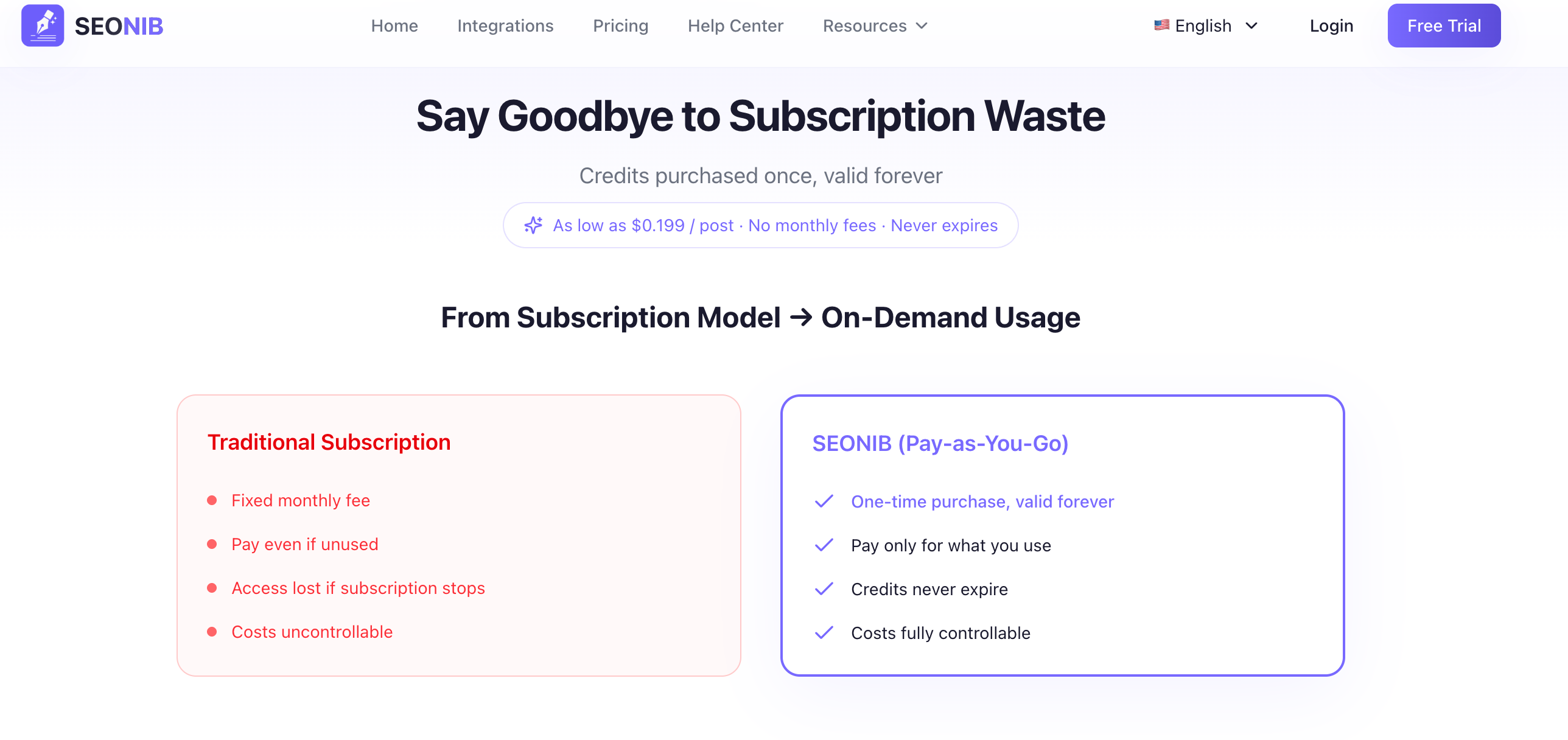
Our strategic shift stemmed from a simple financial observation. Most SaaS tools charge monthly or annually, deducting the fee regardless of whether you produce one article or a hundred in a month. This is extremely unfriendly to teams with unstable content output (especially in the initial and testing phases). We started looking for tools that charge per usage, or at least have more flexible payment models.
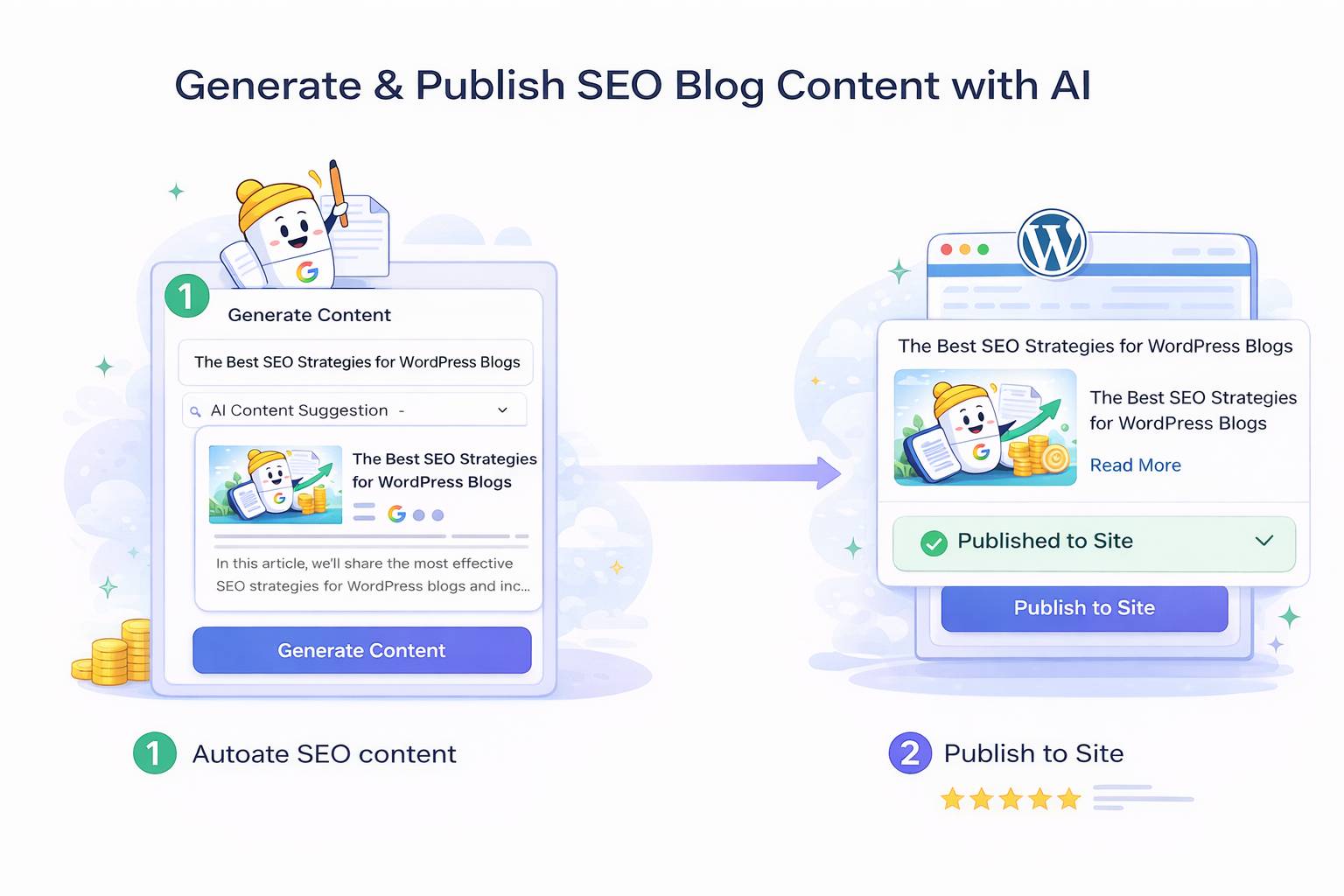
This is how we encountered SEONIB. At the time, we were struggling with content for a batch of newly developed niche language markets; manual translation plus SEO optimization was prohibitively expensive. What attracted us to SEONIB was very practical: a credit system. No monthly fees, just like topping up a transit card – recharge when you run out. This allowed us to boldly test content – generate five articles from different angles for a niche long-tail keyword and see which one gets indexed and clicked first. The cost is clear and controllable, and failure doesn’t sting. It acts as the “main production station” on our content assembly line, automating the most time-consuming steps of “writing, formatting, and publishing,” from keyword analysis to generating drafts with SEO structure, automatic image pairing, and one-click publishing to our WordPress site.
Our “Frugal” Combination Punch: Division of Labor and Checks and Balances
The key to a tool combination is to let each tool do what it does best and form a closed loop of mutual verification.
Trend Discovery and Keyword Verification (Free/Low-Cost Tier)
- Google Trends + Platform “Search Insights”: This is the starting point, free but incredibly important. We found that keywords recommended by AI tools can sometimes have “data illusions,” appearing to have good search volume but might be outdated or semantically biased. We must cross-verify these with free tools. For example, AI might recommend “2026 smart home device,” but trends show real users are searching for “2026 privacy-friendly smart home setup.”
- Reddit / Niche Industry Forums: These are goldmines for uncovering users’ real pain points, colloquial expressions, and long-tail questions. A complaint in a comment section can be an excellent blog topic. This part of the work cannot be fully automated and requires operators to browse with a “detective” mindset.
Content Production and Optimization (Core Variable Cost Tier)
- SEONIB: Serves as the core production engine. We primarily use it for two types of content: “answer-type” articles based on clear long-tail keywords (e.g., “How to fix error code XXX on appliance YYY”); and derivative content for product pages (e.g., buyer’s guides, use cases). Its automatic image pairing and one-click publishing to WordPress save us a lot of formatting and upload time.
- Grammarly / Similar Grammar Tools: Standard for the polishing stage, checking basic language issues. The paid version can offer tone adjustment suggestions, which helps in unifying brand voice.
- SEONIB: Serves as the core production engine. We primarily use it for two types of content: “answer-type” articles based on clear long-tail keywords (e.g., “How to fix error code XXX on appliance YYY”); and derivative content for product pages (e.g., buyer’s guides, use cases). Its automatic image pairing and one-click publishing to WordPress save us a lot of formatting and upload time.
Efficiency and Asset Management (Fixed Cost, but Pursuing Ultimate Cost-Effectiveness)
- Canva Pro: Why not use AI for all graphics? For brand consistency. SEONIB’s automatically paired images are “usable,” but when we need to create infographics, social media banners, or featured images for articles with consistent brand colors and fonts, Canva’s templates and team collaboration features are irreplaceable. Its annual fee is one of the few fixed costs we are willing to pay for design.
- Airtable or Notion: Content calendars, keyword databases, article status tracking, backlink records… all these require a centralized management platform. We use them to manage the content queue generated by SEONIB, mark review status, publication dates, and link to final performance data. Without this, multilingual, multi-platform content publishing would be chaotic.
Pitfalls and Unexpected Gains
- Pitfall: Over-reliance on “Automatic Publishing.” Once, we set SEONIB to batch publish a week’s worth of content to WordPress. Due to a conflict with a website caching plugin, the page layouts were all messed up, and we only discovered it when a user complained via email. Lesson Learned: Even with one-click publishing, a quick check on different devices is essential after the initial publication. Automation saves manual operation, not quality checks.
- Gain: The “Psychological Advantage” of the Credit System. This sounds a bit abstract, but it’s important. When the monthly content strategy focuses on the English market, we can primarily use credits for English content. The next month, when we focus on the Spanish market, we switch over. Without the guilt of “wasting monthly fees,” the team makes decisions more flexibly and boldly, which has led us to discover several unexpected high-traffic niche language directions.
- Pitfall: Risk of Homogenization. If you use an AI tool, your competitors might be using it too. We once found that in a very niche product tutorial area, the top three articles had highly similar structures and even example sentences, clearly the “masterpiece” of the same AI source. Our Response: Based on AI drafts, we must include exclusive screenshots, real user case feedback, and even short operation videos or GIFs we shot ourselves. These “human touches” become our content’s differentiation barrier.
Content Sites in 2026 Rely on “System Resilience”
Ultimately, the goal of this “frugal” combination isn’t to pursue fully unmanned “black technology,” but to build a resilient and sustainable content system. The system includes automated parts (like SEONIB responsible for batch production) and human intervention nodes (like trend judgment, content polishing, and final review). Financially, it’s mostly variable costs, allowing us to expand rapidly when the market is good and tighten our belts without crippling the business when the market is cold.
Tools are always iterating, and new things may emerge next year. But we believe this core principle will not become outdated: Make tools work for you, not you working for tool subscription fees. True efficiency comes from using reasonable costs to free up human energy from repetitive labor, allowing it to be invested in things that require more creativity and judgment – for example, thinking about why your users are searching for that strange keyword late at night.
FAQ
Q1: Is the credit system more expensive than monthly fees in the long run?
A: This depends on your content output. For teams like ours with fluctuating output, the credit system is more cost-effective in most months. In content sprint months, the cost might approach or slightly exceed the monthly fee, but it can be almost zero cost in off-peak seasons. Overall, the total annual expenditure is lower than subscribing to multiple fixed monthly fee tools. Most importantly, cash flow and psychological pressure are healthier.
Q2: How is multilingual content handled? Is it directly translated from English drafts using AI? A: This was an early mistake we made. Direct translation yields poor results and lacks localized context. Now, we use tools like SEONIB to directly generate drafts for specific language search habits using niche language keywords, and then have native speakers or advanced language users polish them. Although there are still costs involved, it’s much cheaper than writing from scratch or purely manual translation, and the SEO foundation is better.
Q3: How do you measure the effectiveness of these AI-generated content? Will it affect website authority? A: We strictly monitor key metrics for each page: indexing time, ranking position, organic click-through rate, dwell time, and conversions (e.g., email sign-ups, product page clicks). If a purely AI-generated article that hasn’t undergone in-depth editing performs poorly over time, we will remove or rewrite it. Content that has been manually optimized and provides unique value typically performs well. Search engines (as of now) judge content quality and relevance, not the production method.
Q4: What stage of team is this model suitable for? A: It’s most suitable for small teams and individual entrepreneurs validating content directions from scratch, and for small to medium-sized enterprises needing to expand into new markets/languages at a low cost. For large companies with very mature content systems and a pursuit of extreme brand tonality, AI-generated content might serve more as inspiration or initial draft assistance, rather than the main driver.