
Bulk Publishing Content? At First I Thought It Was Just a “Lazy” Feature, Until My Site Traffic Multiplied Fivefold
I used to be a content creator who firmly believed in “slow work yields fine results.” For each article—topic selection, research, writing, and layout publishing—I handled everything myself, nurturing it like a seedling. The result? My SaaS product blog was like a delicate but barren garden, barely sprouting a few new leaves a month, let alone attracting any visitors. I comforted myself: quality first.
Then one day I looked at a competitor’s blog, a content fountain churning out several new posts daily, covering all sorts of long‑tail keywords and user questions. I realized that in the SEO game, “capacity” itself is a competitive force that can’t be ignored. Users’ questions are endless, and search engines love fresh, comprehensive content, while my modest “craftsmanship” was just a drop in the vast ocean of internet demand.
So I started exploring “bulk publishing.” To be honest, I was initially resistant, even a bit sarcastic: isn’t this just a content assembly line? Where’s the quality? But reality forced me to try.
The First Pitfall of Scaling Production: What You Think Is “Bulk” Is Just Copy‑Paste
My first attempt was primitive: I hired a writing team, gave them a pile of keywords, and asked for 20 articles a week. The result was disastrous. Styles were inconsistent, quality varied wildly, and some articles read like machine translations. Even worse was the publishing process: I had to log into the backend manually, copy‑paste each article, set categories, tags, featured images… Publishing 20 articles took me an entire afternoon, leaving me dizzy and feeling like a heartless Ctrl +C/V machine.
That wasn’t efficiency; it was shifting the pain of creation to operational pain. What I needed wasn’t “bulk writing,” but full‑process automation from generation to live publishing. While I was staring blankly at the WordPress backend, wondering why life was so hard, I discovered SEONIB.
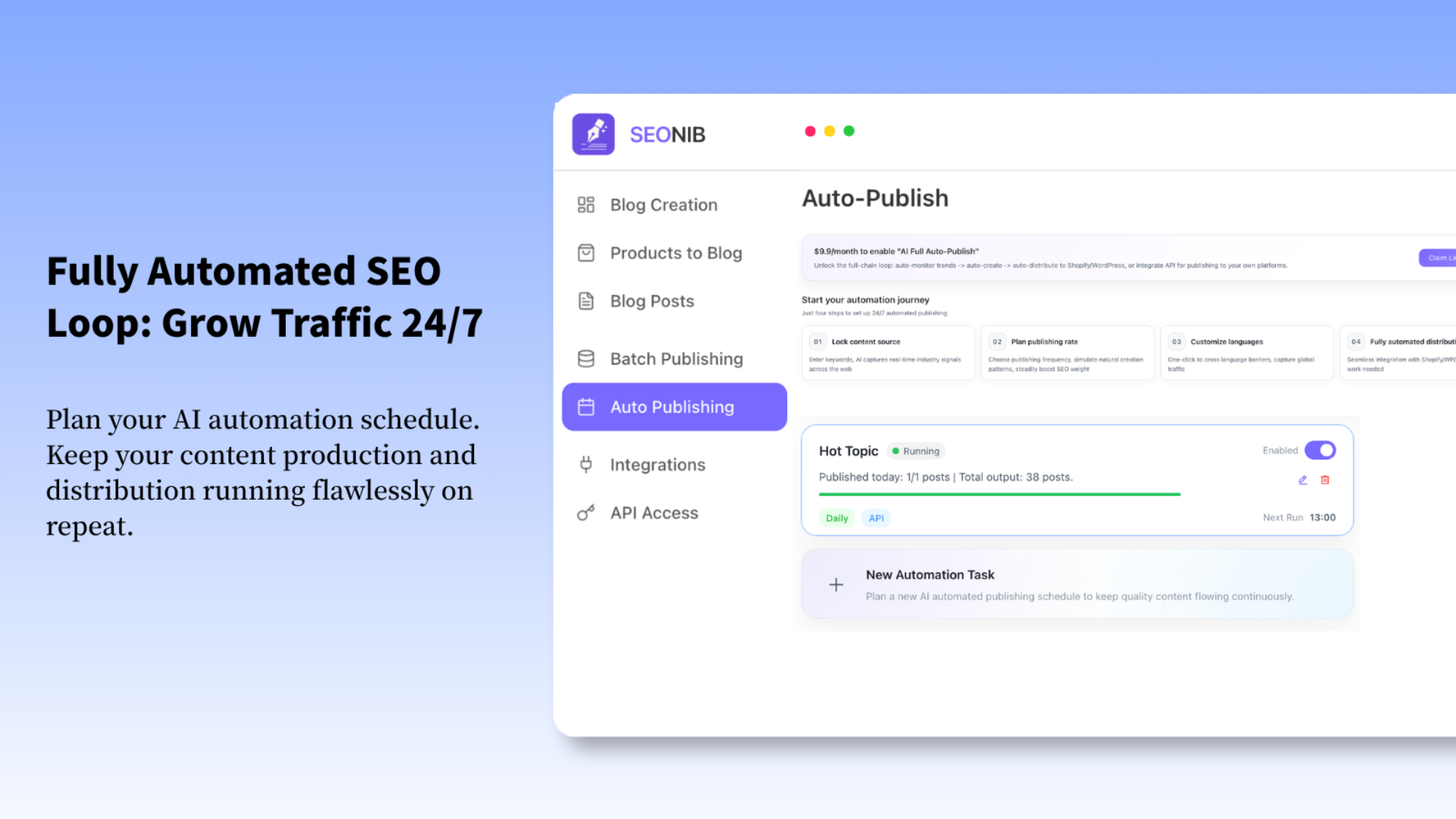
What initially attracted me was simple: it promised to automatically discover trends, generate SEO articles, and publish them with one click. I tried it with a “desperate‑as‑a‑horse” mindset. I set up sources (like industry Q&A and keyword lists), defined a publishing frequency (e.g., two articles per day), and then… I let it run.
A week later I checked the backend and found 14 published articles sitting there quietly. The style was uniform, the structure clear, and—most importantly—search traffic started flowing in. That moment made me realize that true “bulk” isn’t about the number of manual operations, but about the system’s ability to take over repetitive labor. SEONIB acted like a tireless editorial assistant, completely freeing me from the most tedious “搬运”” step.
The Magic of “Unattended” Operations and Unexpected Surprises
When the system runs on its own, I initially couldn’t help refreshing the backend daily, like watching a child learning to walk, fearing a fall (e.g., a flood of nonsense). But soon I discovered that this “non‑intervention” actually brought benefits.
The system generates content based on data and trends, without my personal creative biases or blind spots. It covered topics I’d never thought to write about yet had genuine search volume. For example, my SaaS product targets small‑to‑medium businesses, and I usually wrote core topics like “how to improve team efficiency.” SEONIB automatically generated an article titled “How Remote Teams Manage Meetings Across Time Zones”—a slightly off‑beat piece that consistently brought in inquiry traffic from several specific regions.
That’s the core value of scaling production: using breadth to cover depth‑unreachable corners. A single viral article might bring 1,000 visits, but 100 precisely‑matched long‑tail articles, each delivering 10 visits, also sum to 1,000—more stable and sustained. These scattered visits coalesce into a steady visitor base and send a strong signal to search engines that the site is an authority in its field, with massive, continuously updated content.
Transforming the Content Team from “Creators” to “Curators”
The biggest resistance to scaling usually comes from the team itself. My content editor was initially very resistant, believing AI‑generated content lacked soul and would dilute brand tone. I asked her to temporarily set aside the “author” role and try a new one: curator and optimizer.
We no longer required her to write every article from scratch. Instead, she managed SEONIB’s topic pool and sources, filtered in and injected more professional industry insights, and after automatic publishing, performed quick reviews and “finishing touches”—perhaps adding a real user case in a key paragraph or a more compelling call‑to‑action at the end.
Her workload stayed the same, but output efficiency transformed qualitatively. Previously she could only squeeze out four deep‑dive pieces a month; now she can lead the production of 30 foundational coverage articles and deeply optimize 5–8 of them. The overall content strategy shifted from “point‑burst” to a combination of “area coverage + focused deep‑dive.” Her value wasn’t replaced by a tool; it was elevated—from execution‑level writing to strategic planning and optimization.
Some Harsh Truths About Bulk Publishing
Of course, this path isn’t a bed of roses. These lessons were learned the hard way:
- “Set it and forget it” is a dangerous notion. Regular data checks are mandatory. I once had the system latch onto a fleeting hot topic, generate an article, and the topic vanished two days later, rendering the article useless. You need to regularly refine your source‑material “recipe.”
- Scaling amplifies errors. If the seed keywords you feed the system are biased, or the initial settings are off, the bulk‑generated output will be a batch of biased content. Garbage × 100 equals a dump. Therefore, calibration and sampling checks during the launch phase are crucial.
- It can’t replace genuine thought and brand story. Bulk‑generated content is your “infantry,” occupying search territory. Your “elite troops”—deep pieces that convey core product value and brand vision—still require handcrafted human effort. The two are complementary, not substitutive.
Returning to the beginning, I still believe in “slow work yields fine results,” but I now also trust “division of labor yields efficiency.” Hand over content production that suits scaling, standardization, and data‑driven search demand to an automation system like SEONIB, let AI handle the “whether‑or‑not” problem, and invest the saved precious time and manpower into the creative, strategic, and human‑touch “quality‑vs‑quantity” challenges.
Bulk publishing is essentially not about “being lazy,” but about reallocating resources and structurally upgrading efficiency. When you see your site’s indexed pages jump from dozens to hundreds in a month and the organic traffic curve steadily climb, you’ll know this production revolution arrived at the right moment.
FAQ
Q: Will search engines penalize bulk‑generated content for being low‑quality or duplicate?
A: That was my initial worry. In practice, as long as the content is based on real search demand (driven by keywords, Q&A data, etc.) and maintains sufficient informational value and readability, search engines welcome it. They punish pure keyword stuffing, meaningless text, or plagiarism. The tool is SEONIB, but the “quality baseline” setters and gatekeepers remain you.
Q: How can automatically published content stay consistent with the overall site style?
A: Good tools let you set content templates, including headline style, paragraph structure, and even fixed image libraries. In SEONIB I can predefine intro and outro sentence patterns and brand‑tone keywords. Before publishing there’s a simple preview and edit window for quick tweaks. Consistency is achieved through systematic template settings, not manual per‑article adjustments.
Q: What’s the ultimate effect of doing this? Does it really bring customers?
A: Its direct effect is a massive boost in the site’s “search visibility” and index count. More pages indexed mean more chances to appear in various long‑tail search results. Early traffic may have low conversion rates, but it’s highly targeted potential customers. Over half of our sales leads initially came from a single article a prospect found while searching for a specific problem, automatically published by the system. It builds a continuous, low‑cost traffic funnel.
Q: Do I need to be an SEO expert to use it?
A: Quite the opposite—this is exactly the value of such tools. They encapsulate complex SEO logic (keyword placement, semantic relevance, content structure) inside the system. You only need to provide the “seed” (topic direction, keywords); the system handles “planting and nurturing.” I started as an SEO novice, and the results were even more straightforward because I wasn’t bogged down by technical jargon and could focus on traffic and demand matching.
Q: Will this cause content homogenization? After all, competitors might use the same tool.
A: Good question. The tool is the same, but the “information sources” you feed it, your brand data, product cases, and the unique angles you set are the core differentiators. You can have the system analyze forums competitors haven’t covered, regional search habits, or combine your product’s unique features to generate content. The machine handles production and execution framework; the “strategy and uniqueness” arsenal always remains in human hands.