
Auto‑Write Articles on Trending Topics? I Tried It, and Traffic Doubled
Last year I was still manually chasing trends, panting as I rushed to catch a hot topic on Twitter. I’d open my computer, research, find an angle, force a headline, and after all that effort the article would go out when the hype was already half‑gone. It felt like rushing to a party only to find everyone already cleaning up.
Then I started using SEONIB. Honestly, I was skeptical at first. Can an AI tool understand what a “trend” is? Can it write something people actually want to read? Can it capture that fleeting moment of timely traffic? I treated it as an experiment and set it to fetch trending keywords in the tech and SaaS space.
The First “Sneak Attack” Success Left Me Speechless
I remember it clearly: it was about a newly released API interface standard. Discussion started in developer communities, but mainstream media hadn’t covered it yet. SEONIB’s system (they call it the “Trend Discovery Engine”) caught the signal and automatically generated an analysis article covering use cases, migration costs, and potential issues. The structure was so clear it didn’t feel AI‑written. I published it almost immediately.
The next day, search traffic for that article started flowing in—not a little, but like a faucet suddenly turned on. Because it was published early enough and the content was useful (even foreseeing pitfalls developers would later encounter), it landed at the top of search results. That month’s organic traffic report showed a clear peak driven by a single trending topic for time made me rethink the value of “trending content.” It isn’t necessarily shallow or attention‑seeking. In a professional field, a timely, in‑depth “hot article” that solves early‑stage searchers’ confusion is a high‑quality content brick that can stay in search results for a long time, continuously bringing visits. The key is how fast you act and how precisely you cut into the topic.
From “Chasing Trends” to “Laying in”
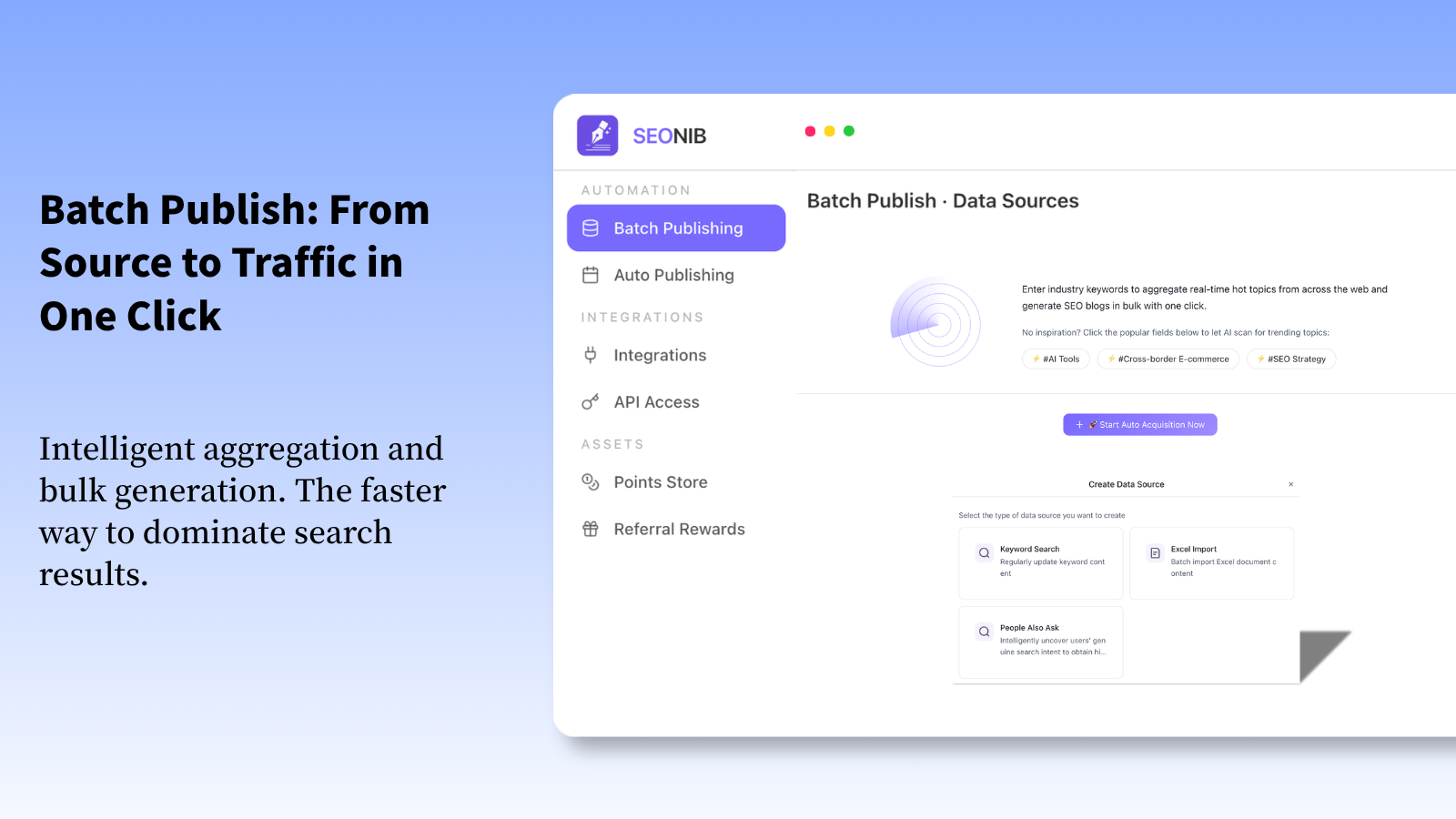
Manual work always puts you in the “chasing” mode. You have to see the trend first, then act. SEONIB‑type tools work as “ambush.” By continuously analyzing search data, community discussions, and even the frequency of specific keyword queries, they sniff out a topic before it explodes into a mainstream trend. That “time gap” is the golden zone you can capture.
I later refined my strategy. Instead of covering all trends, I focused on my core business areas (SaaS tools, automation workflows). The articles generated are hot in topic but cold in core—professional and aligned with my site’s overall tone—so my blog doesn’t look like a chaotic news dump.
An unexpected side effect: Because these hot articles bring initial traffic, those visitors also browse other, more regular and fundamental tutorial posts on my site. The hot articles become “traffic magnets,” pulling waves of new visitors into my content ecosystem. The overall page index count of the site also climbs—search engines see that the site can continuously produce timely, relevant professional content and are more willing to index other pages.
The “Fails” and Awkward Moments Worth Mentioning
Not every trend is worth following. Once, the system caught a highly controversial industry rumor and automatically generated a relatively neutral analysis piece. I published it, and the comment section erupted with two opposing camps, turning the atmosphere toxic and almost attracting irrational attacks. I eventually took the article down.
This taught me a lesson: trend tools give you speed and content, but not editorial judgment. You still need to be the final gatekeeper. Especially for controversial, unverified, or potentially negative community‑reaction topics, human judgment is indispensable. I set SEONIB’s discovery sources to be more conservative, focusing on tech updates, product releases, and data reports—hard trends.
Another awkward issue is “homogenization.” When a big trend appears, if many site owners use similar tools and data sources, the generated article structures and even arguments can be identical. You might grab a position early, but soon the search results fill with several “AI siblings,” diluting your uniqueness. My workaround is to manually add a genuine case or observation from a client or a real project on top of the AI‑generated framework. Even 300 words give the article a human fingerprint.
So, What Did It Actually Change?
At its core, tools like SEONIB turn “trend content production” from an artistic creation process that depends on personal inspiration, speed, and effort into a monitorable, trigger‑able, batch‑executable operational workflow. They solve not “how to write a good article,” but “how to get the article in the right place at the right time.”
My site’s exposure grew not because every hot article was a masterpiece, but because:
- Coverage increased: I can cover more potential trends without missing any.
- Publication time moved forward: I shifted from being a “reporter” to an “early analyst.”
- Content base expanded: More indexed pages built a sturdier traffic foundation.
It works like an automated sentinel and rapid‑response unit, while I remain the commander deciding strategy and direction. This combination has, over the past year, given my blog a sustainable level of visibility in the fiercely competitive SaaS content arena.
FAQ
Q: Will AI‑written hot articles be low‑quality and hurt my site’s authority?
A: Quality depends on your settings and source material. If you let it generate from shallow data, the article will be shallow. In my experience, feeding it high‑quality initial sources (industry report keywords, official doc updates, core forum topics) yields a solid framework. A quick polish and case addition make the quality fully controllable.
Q: Will automatically chasing trends make my blog’s theme scattered?
A: Yes, if you don’t limit it. The key is “focus.” Set the tool within your professional domain. I restrict it to SaaS, automation, and specific tech stacks, so even hot topics stay vertical and don’t dilute brand positioning.
Q: Is trending traffic only temporary with no long‑term value?
A: Not entirely. An early analysis of a tech trend (e.g., a new framework release) can become the go‑to answer for queries like “how to migrate to XX” or “XX framework beginner guide.” After the peak, it turns into a stable, demand‑driven tutorial that continues to attract search traffic.
Q: Do I need a lot of technical knowledge to set up such a tool?
A: Almost none. My setup was: choose a domain (SaaS/tech), input a few authoritative source sites I regularly read, set a publishing frequency. The rest is automated. The hardest part may be the initial tweaking of sources so the “trends” it catches match your taste.
Q: Could publishing too fast lead to factual errors?
A: It has happened. An early version once generated an article with a small mistake due to incomplete information. Later, the tool iterated and cross‑checked multiple sources before generation. More importantly, quick pre‑publication review is your responsibility. Spend five minutes verifying key facts and data—that’s a necessary step.