
SEONIB Smart Scheduling: Turning Site Updates from Accidental Events into a Systematic Growth Engine
I remember when I first tried to get natural traffic through content, the thing that bothered me most wasn’t that I couldn’t write articles, but that the articles I did write felt like a burst of fireworks—brilliant for a moment, then silent. I would stay up late to churn out a long piece on a hot topic, and it would indeed bring a few days of good traffic after publishing. But what then? My attention would shift back to product development, the blog would fall silent again, and I would wait for the next spark of inspiration or crisis. This pulse‑like update pattern produced a traffic curve that looked like an occasional spike on an ECG: peaks, but the baseline stayed low. I realized the core issue wasn’t content quality, nor even keyword selection, but the rhythm of updates itself lacked system and predictability. Search engines, at their core, are observers that crave a stable signal; they prefer sites that regularly and continuously provide fresh, relevant information over talented but erratic “artists”.
From “Publishing Content” to “Operating a Content Pipeline”
The shift happened when I upgraded my mindset from “publishing article after article” to “operating a content pipeline”. This wasn’t just a mental change; it required concrete tools and processes. The heart of smart scheduling is moving the publishing time from a “manual decision” based on personal state to an “automated decision” driven by data and goals. I started setting a publishing frequency for my site, for example, every Tuesday and Thursday at 9 AM. This timing wasn’t arbitrary: it avoids the Monday morning chaos and Friday afternoon sluggishness, and it considers the likely consumption habits of my target readers. More importantly, it became an unshakable commitment, not just to myself but to my site and the search engines. Once the schedule is set, content must be delivered at that time, forcing me to build a backend system that can reliably produce content.
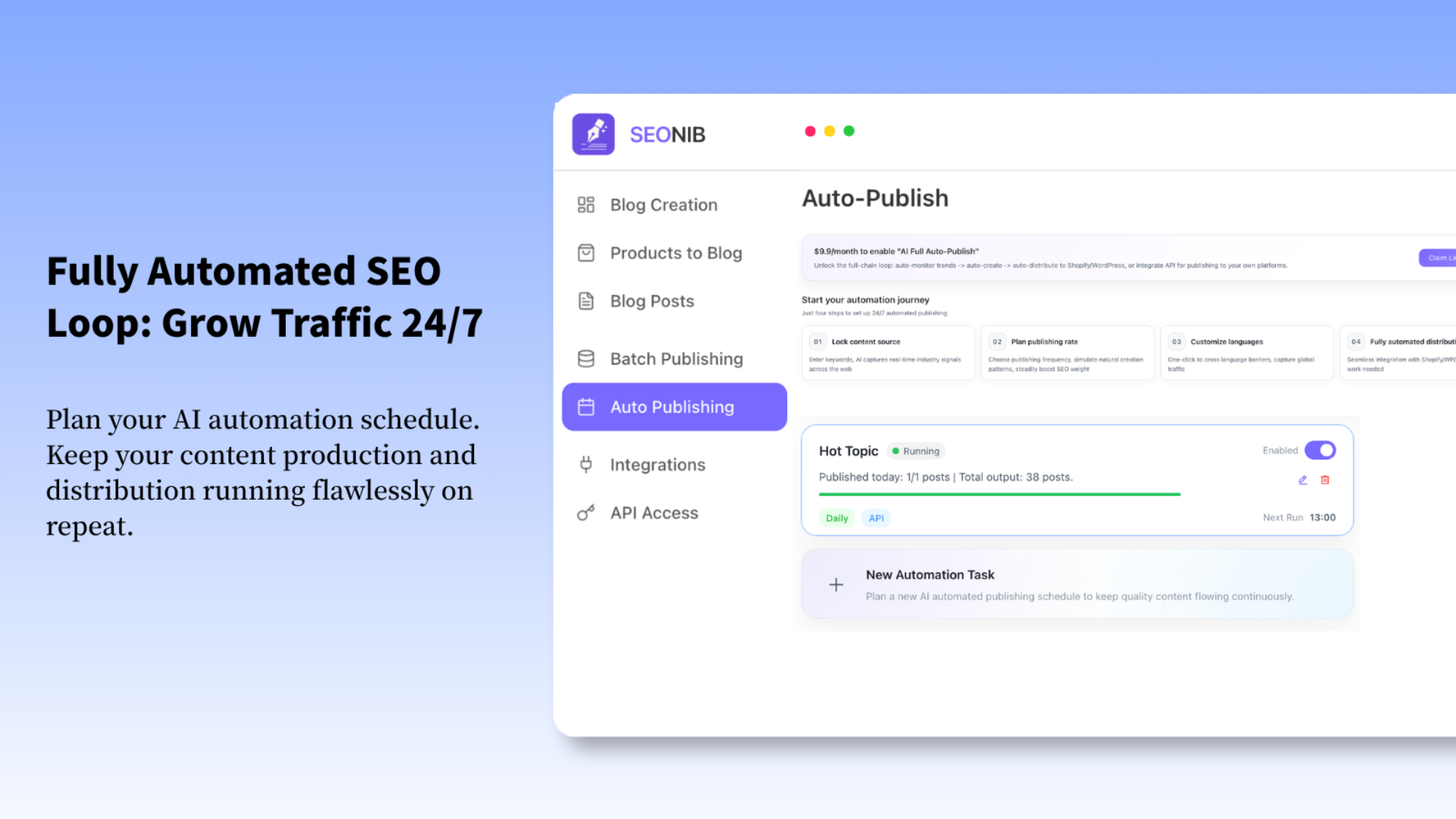
Initially, this backend system was still me. I pre‑planned topics, stockpiled drafts, and tried to finish before the scheduled slot. That quickly dragged me back into a time‑management quagmire. True liberation came when I also automated the content‑generation step. That means smart scheduling is no longer just “timed publishing” but “timed triggering of the whole process from trend discovery to content creation to publishing”. The tool I use is SEONIB, which acts as the automated controller of this pipeline. I simply set the information sources (e.g., specific industry Q&A platforms or keyword lists) and the publishing frequency, and the system automatically completes trend analysis, article generation, and deployment before the scheduled time. SEONIB’s role here is like a precise digital workshop scheduler, ensuring that each scheduled node has a qualified product ready for delivery.
Hidden Benefits of Stable Updates: Trust and Inertia
After a few months of regular updates, I noticed subtle changes beyond raw traffic numbers. The most noticeable was a clear increase in the frequency of search‑engine crawler visits. They seemed to get used to fetching goods from this “content conveyor belt” on a schedule, making their visits more regular and deeper. This directly accelerated the indexing speed of new content. An article published on Thursday at 9 AM might be initially indexed within a few hours, rather than waiting an uncertain one or two days as before.
Another deeper benefit was user‑behavior inertia. While my readers don’t come every day, those who find me via search and notice that the site constantly offers new information develop a subconscious trust. They may return to search when they have a related question because they vaguely remember “this site always updates on this topic”. This trust is something pulse‑like updates can never build. Stable updates create a sense of professionalism and reliability, telling both readers and search engines: this is an active information hub for a specific field, not a random notebook.
Strategic Considerations Behind Scheduling: Rhythm, Density, and Sustainability
When setting the schedule frequency, I made a few missteps. At first, I ambitiously set a daily update, trying to crush everything with sheer density. That quickly caused two problems: content quality fluctuated under pressure, and overly dense updates diluted each piece’s exposure window—they became hurried passers‑by that didn’t have time to accumulate enough ranking weight before being overtaken by the next article. Later I adjusted to two or three updates per week, a rhythm that gave me (or my automation system) enough time to digest a topic, allowing each article roughly three to four days of “independent climbing period” to fully capture search traffic.
Another often‑overlooked strategic point of smart scheduling is mixing content types. My schedule isn’t just long‑form blog posts. I intersperse short Q&A pieces generated from “People Also Ask”, or data updates to older articles. This mix is like rhythmic variation in music, preventing the update flow from becoming monotonous and covering search intents of different depths. Q&A content can quickly capture precise short‑tail traffic, while in articles build the site’s authority foundation. The scheduling system lets me allocate these different “ammunition” types deliberately rather than randomly.
When Scheduling Meets Reality: Holidays, Traffic Lulls, and System Resilience
Of course, no system can completely ignore real‑world fluctuations. During holidays, overall search traffic drops and my target audience may not be at work. Initially I wrestled with whether to pause the schedule. I chose to keep updating, simply adjusting the nature of the content—perhaps publishing more forward‑looking, summary‑type, less urgent pieces. The thinking behind this is that the “stability” of the schedule itself is a signal; even during a lull, maintaining output reinforces the search engine’s perception of the site’s activity. Moreover, content published during a lull often experiences a surge of traffic once the holiday ends, so it isn’t wasted.
Another test occurs when the automated content‑generation system, due to abnormal trend data or technical issues, produces a sub‑par article. Do I stick to the schedule or intervene manually? My principle is to publish in the vast majority of cases. One imperfect piece causes only a minor, fixable dent in site authority; a broken schedule, however, undermines the system’s regularity and trust. I’ll let the article go live, then adjust the information source or generation parameters in subsequent scheduled tasks based on its performance. It’s like maintaining an industrial assembly line: occasional product defects can be corrected through process improvements, but stopping production arbitrarily causes greater loss.
The Ultimate State of Smart Scheduling: Turning a Site into a Self‑Growing Digital Asset
Today, smart scheduling for me has long surpassed the simple “timed publishing” feature. It is the core mechanism that transforms my site from a project that needs continuous feeding into a digital asset with autonomous growth capability. Scheduling, combined with automated trend discovery and content generation, forms a closed loop. This loop doesn’t require me to think daily about “what to write today”, nor to click publish manually. It runs in the background based on the goals and rules I initially set, acting like a digital lighthouse that regularly emits signals, attracting ships in the sea of search.
My focus shifted from “what’s the next piece of content?” to “the health of the entire content ecosystem”: Are the indexed page growth curves smooth? Is the traffic proportion across language versions reasonable? Are core topics being continuously deepened? Scheduling ensures sustained growth, allowing me to observe and optimize the whole system from a higher vantage point rather than getting stuck in the details of each article. That is the true meaning of efficiency: not just completing a task faster, but making the task disappear into the background so you can focus on strategic judgments only humans can make.
FAQ
Q: Is a higher scheduling frequency always better? For example, daily updates?
A: Not necessarily. High‑frequency updates require strong content‑production capacity, otherwise quality suffers. More importantly, each piece needs time to be indexed and accumulate ranking weight. Overly dense publishing shortens the independent climbing period of each article, which can hurt long‑term rankings. For most sites, 2‑4 updates per week strike a balance between sustainability and growth efficiency.
Q: Should I pause scheduling during holidays or traffic lulls?
A: In my experience, try not to pause. The core value of scheduling is establishing a “stable” signal. Pausing breaks that regularity. You can adjust the content direction during low‑traffic periods to be more summary‑, forward‑looking, or foundational, which still holds value when traffic rebounds. Maintaining updates reinforces the search engine’s perception of site activity.
Q: If an automatically generated piece is of low quality, should I still publish it on schedule?
A: Unless the content contains serious factual errors or negative issues, I recommend publishing on schedule. One imperfect piece has limited, fixable impact on site authority. Interrupting the schedule would damage system regularity. A better approach is to publish, then use its performance data to tweak the information sources or parameters for future generation, allowing the system to self‑optimize.
Q: Is smart scheduling only for blog posts?
A: No. It can be applied to any content type that requires regular updates, including product changelogs, industry news briefs, Q&A content, data reports, etc. Mixing different content types in the schedule makes your update flow richer and covers a broader range of search intents.
Q: How do I know if my scheduling strategy is effective?
A: Look beyond single‑article traffic spikes and focus on several macro metrics: the frequency and regularity of search‑engine crawler visits; the average speed at which new content is indexed; the smooth upward growth of total indexed pages; and whether the baseline of organic search traffic is steadily rising rather than relying solely on occasional peaks.