
Stop the grind, let AI “copy” the competition: My quick benchmarking and original‑generation practice
Friends, lately does creating content—especially SaaS content—feel more like playing a “spot‑the‑difference” plus “prompt‑writing” game? You stare at a top‑ranked competitor article, mentally tallying: learn the structure, avoid the viewpoints, cover the keywords, and finally appear deeper than they are. In the past I did this by opening dozens of tabs, making Excel tables, and spending half a day to produce a “patchwork monster” whose quality varied wildly.
Then I changed my approach: since competitor analysis is essentially deconstruction and recombination, why not let an AI that excels at pattern recognition lead the way? Today I’ll share how I turned the painful task of “quickly benchmarking competitors and generating high‑quality originals” into a semi‑automated pipeline. The core isn’t “copying” but “reverse‑engineering” followed by “forward innovation”.
My round‑about way: from “pixel‑level imitation” to “structural transcendence”
At first I, like everyone else, believed in “pixel‑level imitation”. When a competitor’s article used the “5 pain points – 3 solutions – 1 tool” structure and went viral, I copied it outright. The result? Search engines may flag it as low‑quality duplicate content, and users see another stale marketing piece. The worst part is you’re always one step behind.
Later I realized that what you need to “copy” isn’t the words, but the logical skeleton and intent coverage behind the article. Why do they place “cost savings” in the second section instead of the conclusion? What data do they cite? What questions are users asking in the comments that weren’t addressed? Those are the gold.
Doing this analysis manually is too slow. I needed a tool that could ingest a competitor article URL and dissect it like a surgeon. It should tell me: what the core keyword clusters are, the semantic logic of H2/H3 headings, the emotional trajectory of the content, and even which paragraphs are likely “fluff”. That lets me spend my time on higher‑level judgments: where can we differentiate? Where can we provide deeper insight?
Efficiency turning point: when “analysis” and “generation” sync up
In my workflow, the real breakthrough came from making “analysis” and “generation” no longer disjoint. I stopped spending two hours writing a detailed analysis report and then painfully creating content based on it.
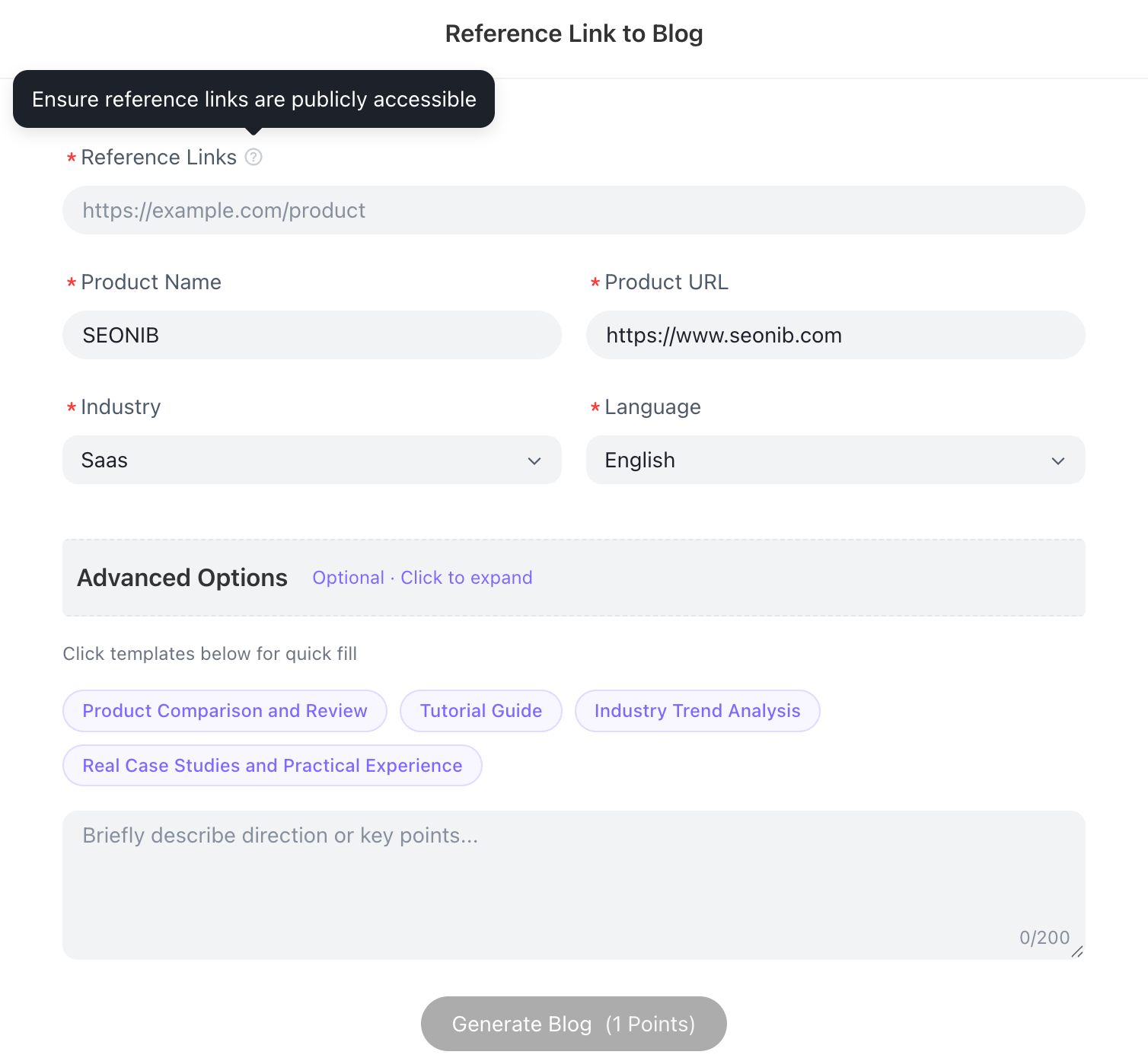
Specifically, I found a pivot that links the two steps. For example, I use a platform like SEONIB. Its value isn’t in replacing my thinking, but in providing an efficient “workbench”. I can drop a competitor’s high‑performing article link into it, and it quickly generates a structurally aligned draft whose content has been semantically re‑organized and expanded. Note: this is only the starting point, a “shell”.
The key is that tools like SEONIB give you analytical perspectives (keyword density, paragraph intent, hot topics in the same theme) that serve as a high‑level analysis foundation. I don’t start deconstructing from scratch; I start from a preliminary blueprint and think about optimization. This saves a huge amount of mechanical information‑sorting time.
The soul of originality still lies in your hands
Here’s the most important misconception to clear up: an AI‑generated benchmark draft is not ready‑to‑publish original content. At best it’s a “look‑alike” and “non‑plagiarized” sketch. The real “magic” comes from you.
My usual process is:
- Add exclusive insights – Can the “pain points” mentioned in the draft be backed by a real story from one of our customers? Even a screenshot or a direct quote instantly boosts authenticity.
- Update data and cases – The competitor might be citing a two‑year‑old industry report. I swap in the latest numbers, even if it’s just a growth‑forecast chart released last month by a reputable agency.
- Strengthen actionable details – The competitor may vaguely say “easy integration”. I write, “In our dashboard, you just click ‘Authorize’, then select the Slack channel from the dropdown, and notifications will automatically …”. This granularity is something AI can’t conjure out of thin air.
- Adjust tone and stance – If the competitor’s voice is “educating the user”, I might adopt an equal‑partner perspective like “discussing with peers”. Humor is added here too, e.g., when explaining a complex feature, I’ll slip in, “I know this sounds like teaching a cat to code, but the actual steps are only three.”
After this “hand‑crafted refinement”, the article carries both the competitor’s traffic DNA and your unique brand imprint and depth. It’s no longer a copy; it’s a more practical, prettier building erected on the original foundation.
Some unexpected “side effects” and insights
After running this process for a while, I noticed a few interesting points:
- You end up focusing more on the essence of the content – Because structural analysis is automated, you’re forced to think about the deeper layer: what unique value do we truly provide? This raises the strategic level of the content.
- The “benchmark” scope can broaden – You don’t have to limit yourself to direct competitors. Viral articles targeting the same audience but from different industries (e.g., marketing vs. SaaS) may have structures and storytelling techniques worth reverse‑engineering.
- Beware the “averaging” trap – Over‑relying on tool‑generated analyses of many competitors and then averaging them can produce a bland, “safe article” with no edge. Sometimes the top‑ranked piece succeeds precisely because it has a bold, distinctive viewpoint.
In the end, tools free you from the “manual labor” so you can concentrate on “creative work”. Using AI to benchmark competitor structures is like using a telescope to see the track and opponents clearly; the final run and strategy still depend on your “experienced driver” feet and brain.
FAQ
Q1: Will using AI to generate articles get me penalized by search engines?
A: If you publish the AI draft as‑is, the risk is high. After deep processing—adding abundant exclusive insights and facts—the article gains significant originality and value. Search engines penalize low‑quality, duplicate, user‑useless content, not a specific generation method.
Q2: How can I ensure the output isn’t just “repackaged same old thing”?
A: The key is your “processing checklist”. I mandate that every article contain: at least one real (anonymized) user case of our product, a set of the latest industry data from the current year, and a QA that the competitor didn’t cover but users frequently ask. This fundamentally changes the content’s DNA.
Q3: Does this workflow suit all types of content?
A: It works best for logic‑driven, structurally clear pieces such as product docs, industry analyses, and solution‑oriented articles. For content that requires strong brand personality, narrative depth, or emotional resonance—like brand stories—AI can only help supply material; the core conception must still come from you.
Q4: Will it cause the team’s writing ability to decline?
A: Quite the opposite. It frees the team from mechanical “structure building” and “basic information gathering”, forcing them to upgrade to higher‑order skills: deep client interviews for case studies, industry data analysis, and crafting unique viewpoints. It’s essentially a writing‑skill upgrade.
Q5: Where is the biggest efficiency gain?
A: The most noticeable is “startup speed”. Going from staring at a blank page to having a structurally complete, data‑filled draft shrinks from hours to minutes. This lets content teams respond to trends or run quick tests much more nimbly.