My SEO Content Farm: From “Daily Update Anxiety” to “Lying Down While Collecting Traffic” – A Fantastical Drift
You might not believe it, but at this time last year I was still pulling my hair out over “what to post today”. I was running a SaaS blog for a global audience, and the content demand was a bottomless pit—technical updates, product tutorials, industry insights, and I had to cover English, Spanish, Japanese, and several other languages. The team consisted of me and two part‑time editors; the three of us staring at blank documents became a daily comedy routine.
The most ironic thing was that we painstakingly crafted an “epic” technical long‑form article—researching, drawing charts, polishing the copy—spending a week on it. After publishing, the traffic curve was as flat as my ECG. In contrast, a small tip I casually wrote one day to solve a particular error inexplicably went viral. At that moment I realized: SEO can be like a relationship— the harder you push, the more it ignores you.
From “Human Crawlers” to Letting AI “Surf”
The initial clumsy method was to become a human trend detector. I spent each day on Reddit, Hacker News, and various community forums, trying to fish out topics that were “about to go viral” from the massive information flow. The result was usually that the “trend report” I compiled late at night was already as cold as overnight coffee by the time the article was published. That perpetual lagging‑behind frustration was more than enough.
I also tried a bunch of keyword tools, but they often suggested topics that were already over‑saturated, with competition as intense as the morning rush hour subway. What we needed were “potential stocks”—real search demand but unsaturated content supply. Manual filtering was painfully inefficient.
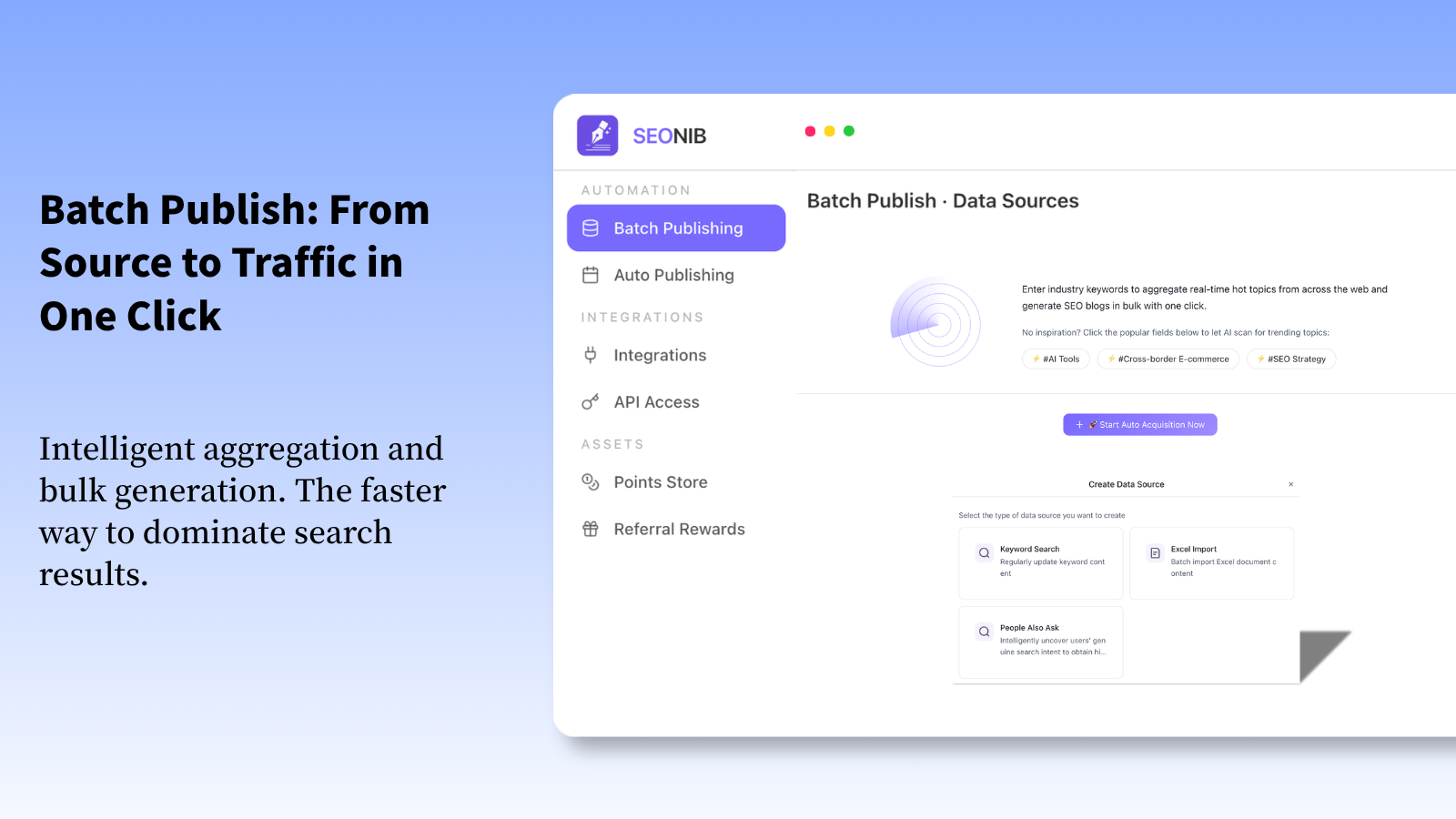
The turning point came when I handed over part of the experimental content generation work to an AI SEO tool called SEONIB. Of course, at first I was skeptical, thinking it was just another “IQ tax” gadget. Its first eyebrow‑raising feature was the so‑called “trend discovery”. Instead of simply giving me a list of high‑search‑volume keywords, it combines emerging community discussions, competitor update dynamics, and even the update frequency of technical documentation to assess a topic’s “growth potential”. It’s like hiring an tireless scout monitoring hundreds of information sources at once.
The Birth of a “Hit”, Often Not Following the Script
After using SEONIB, the most interesting (and relieving) observation was that the content that actually brings sustained traffic is often not the “main character” we had planned. We outlined a series of deep product analyses, but a small tip about integrating a third‑party tool that we casually mentioned in the series was expanded by the AI into a standalone how‑to guide, and that guide alone accounted for half of the series’ total traffic.
AI seems better at capturing concrete, problem‑solving “instant” needs rather than grand conceptual expositions. This forced us to adjust our content strategy: instead of aiming for all‑encompassing “ultimate guides”, we now create more “stepping stones” that address specific scenarios and error codes. Each stepping stone may generate modest traffic, but in aggregate they form the main pathway for users to discover us.
Generating multilingual content has been a journey from joke to legend. In the early days we relied on translation software, which produced many “legendary mistranslations”, such as translating “backend” as “后腰” (lower back). The multilingual generation of tools like SEONIB is not a simple translation; it reorganizes the content according to the search habits of the target language. An unexpected benefit is that the technical articles generated for the Japanese market are especially rigorous and step‑by‑step, which has become one of our distinguishing features.
When Content Starts to “Grow” Automatically: A Wake‑up Call About Authority and Ownership
As automatically generated and published content increased, a real‑world problem hit me: who actually owns the traffic and SEO authority? The content is published under a third‑party platform’s subdomain or the tool’s default domain, which feels like renovating a rented apartment—never quite reassuring.
This brings us to the crucial issue of flexible domain names and API deployment. A good tool should provide a clear path to return asset ownership to the user.
- Free temporary domain: Suitable for rapid start and testing. You can first check whether the AI‑generated content style and SEO performance match your expectations, with zero cost for trial and error. But it’s like a fitting room—you can’t live in it forever.
- One‑click binding of your own domain: This is the key step. Bind your blog subdomain (e.g.,
blog.yourcompany.com) or a standalone domain. From then on, all inbound links and search authority accumulate under your own domain asset. This is the true “digital real estate”, not just content leasing.
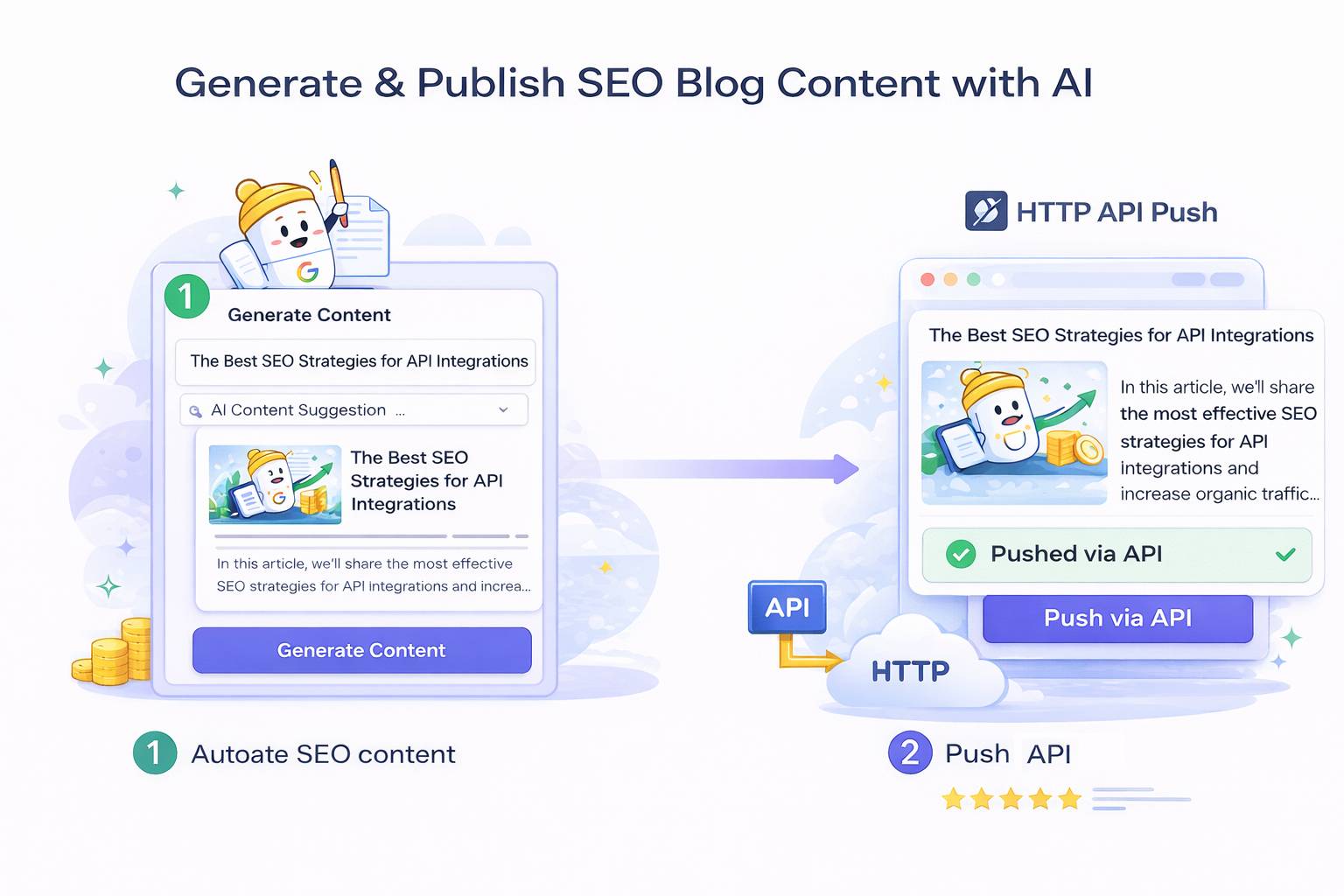
- Open API: For SaaS companies, content is not an island. You need to automatically sync blog posts to the product help center, push them to community forums, or use them as email marketing material. An open API lets you integrate this “content engine” seamlessly into your entire business system, achieving one‑time generation with multi‑place empowerment.
At that time I used SEONIB’s API to automatically summarize the weekly generated industry trend analysis articles and sync them to our product’s user dashboard as an “Industry Updates” module. This added extra informational value to our product, and users stayed longer. That’s the value extension of automated content.
After Publishing, the Story Just Begins
I once naïvely thought that clicking “Publish” was the end. Later I realized it was just the beginning. Is the content indexed by search engines? How fast is the indexing? Which articles have the potential to become evergreen? All of these need monitoring.
Some tools provide index‑status tracking and AI re‑recommendations based on content performance. For example, if an article about “API rate‑limit strategies” has a low bounce rate and high completion, the tool will automatically suggest: “This topic is popular; you can generate related series content such as ‘Rate‑limit Algorithm Comparison’ and ‘Best Practices for Over‑limit Handling’.” This turns the content strategy from a “guess‑work” approach into a data‑driven one, creating a discovery‑generation‑publish‑analysis‑rediscovery loop.
Seeing the continuous traffic from different regions around the world in the backend feels quite magical. Those articles I never wrote a single line of code for are working 24⁄7, attracting potential users. I have finally moved from being a “daily‑update anxiety” patient to a “content farm owner” who occasionally tweaks the strategy. Of course, strategy and direction always require human oversight; AI is an excellent executor but not yet a commander.
FAQ
Q: Will Google penalize fully AI‑generated content?
A: From my experience, Google’s algorithm increasingly values the content’s usefulness and relevance rather than its origin. As long as the content genuinely solves user problems, is accurate, and well‑structured, it has a chance to rank regardless of who wrote it. After AI generation, having humans fact‑check and fine‑tune brand tone is a good practice.
Q: How to ensure professionalism in multilingual content, especially in technical fields?
A: Relying entirely on AI is risky. My approach: for non‑core technical documents, use AI to generate a draft, then have native‑speaking technical colleagues review key terminology and logic. For core product documentation, we still rely primarily on humans. AI is better suited for high‑volume, long‑tail, operational or information‑aggregation type content.
Q: How to ensure automatically published content doesn’t clash with other marketing activities?
A: This is where API and calendar integration come into play. I use a unified content calendar to list AI auto‑publish schedules, manual writing plans, product update announcements, and marketing campaigns, avoiding information overload or theme collisions on the same day. Some advanced tools also support dynamic adjustment of generation plans based on the release calendar.
Q: Is it technically complex to bind your own domain?
A: It’s simpler than you might think. Mainstream tools usually provide a CNAME record that you add in your domain registrar (e.g., Cloudflare, GoDaddy) just like setting an MX record for email. The whole process can be completed in under ten minutes with detailed instructions.
Q: In the long run, what is the biggest risk of SEO content automation?
A: The risk of homogenization. If everyone uses similar prompts and approaches, the internet will be saturated with “AI‑tone” content. The biggest moat remains your unique industry data, user case studies, and product insights. Treat AI as a magnifier and efficiency tool to scale the “shell” and “tentacles” of your exclusive viewpoints, not as the core itself.