
SEO Bulk Generation: When Your Blog Needs to Become a Factory Assembly Line
In 2026, if you’re still writing blog posts one by one, pairing them with images, publishing them, and then praying that search engines will notice, you’re likely behind by more than just one era. This isn’t alarmist talk; it’s a conclusion drawn from personally witnessing several content projects transition from “meticulously crafted” to “overwhelmingly scaled” over the past two years. The SEO battlefield has long shifted from the “quality” of individual pieces to the “quantity” and “automation” of broad coverage and continuous output.
Why Has “Bulk” Become an Unavoidable Option?
Initially, my team and I firmly believed in “content is king.” We would spend a week perfecting an in-depth industry analysis, complete with exquisite images and a rigorous structure. After publishing, it would indeed achieve a decent initial ranking and some shares within professional circles. We were smug.
Then, we observed a competitor. Their blog update frequency was terrifying; new content went live daily, covering a dizzying array of topics, from core product tutorials to extremely niche user scenario problems. The quality of individual pieces seemed… well, “passable.” Some even appeared to be generated from templates. But miraculously, their overall website traffic grew exponentially within three months. A large volume of long-tail keywords began to rank. This scattered traffic converged, forming a stable river of visits that eventually flowed into the ocean of core product pages.
We realized a problem: search engines (especially those that have undergone multiple AI iterations) evaluate a website’s authority and value not just by the depth of individual content, but also by its ability to systematically and continuously satisfy users’ diverse search needs within a domain. A website with ten exceptional articles is less likely to be deemed a “reliable resource hub for the field” than one with five hundred articles covering every possible user question from beginner to expert. This logic became even more apparent in 2026.
Thus, we were forced to consider scaled production. But we immediately encountered the classic triple dilemma:
- Cost Dilemma: Hiring a team of writers? The budget would explode. Manually operating GPT-like tools? The time cost would still be daunting, requiring extensive prompt debugging and post-editing.
- Process Dilemma: Scaling isn’t simply “writing more.” It involves: topic sourcing (how to batch acquire potential keywords or questions), content generation (how to ensure basic quality and avoid repetition), asset processing (especially images; finding an image for every piece would drive you mad), and publishing deployment (uploading to a CMS is manual labor).
- Uncertainty of Results: What if the bulk-produced content is all garbage, not indexed, and actually damages the website’s credibility?
The Turning Point from Manual “Workshop” to Automated “Assembly Line”
We tried piecing together various tools: exporting lists from keyword tools, batch generating text via AI APIs, batch generating images with another tool, and then uploading to WordPress using scripts. The process was a disaster. File formats were jumbled, API calls failed, image styles were inconsistent, and uploads were interrupted mid-process. Maintaining this fragile “pipeline” itself became a full-time job.
The real turning point came when we started looking for solutions that could “encapsulate” the entire process. What we needed was a system that could accept bulk input (like a basket of keywords or product information) and then automatically complete the entire process from content generation and image pairing to publishing. It was then that we discovered SEONIB.
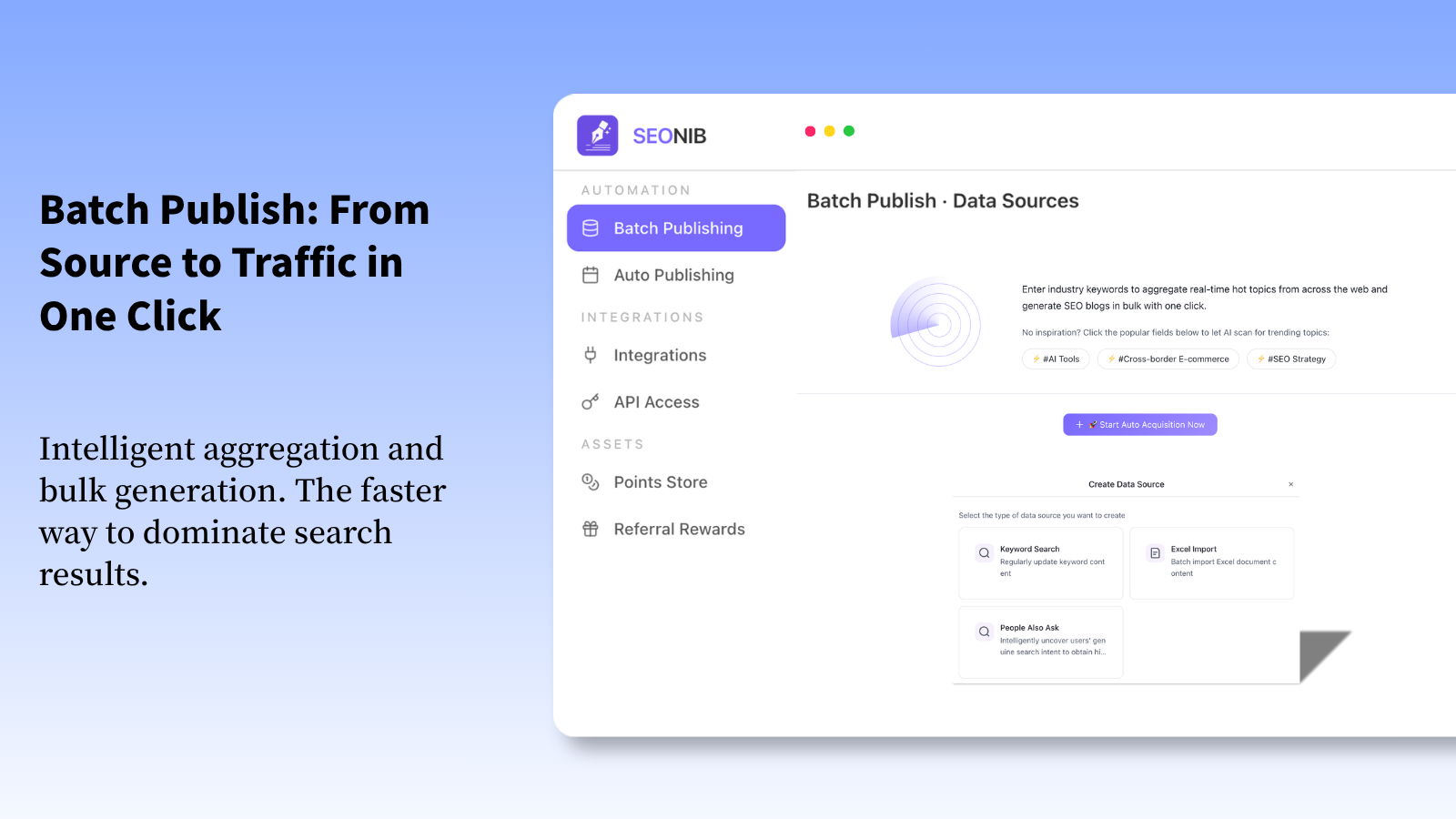
What initially attracted us was very practical: its way of handling bulk tasks was like a workshop set up with parameters to run automatically. You could import an Excel spreadsheet containing hundreds of keywords, or directly input a product page link. The system would then, based on these materials, automatically plan different content types (buying guides, tutorials, FAQs, scenario recommendations, etc.) and generate a large volume of articles at once. More importantly, it included automatic image pairing and one-click publishing to multiple platforms (like WordPress, Shopify). This perfectly solved the most troublesome connection issues in our “process dilemma.”
During our first test, we imported a list of 50 long-tail keywords. After setting it up, the system began to run. Our team’s mindset at the time was a mix of anticipation and skepticism. A few hours later, 50 blog posts, each with a relevant themed image, were neatly lined up in the publishing queue. Clicking “bulk publish,” they were quietly and orderly pushed to our website. The entire process required less than ten minutes of human intervention.
Cost-Effectiveness and the “Credit System” for Peace of Mind
In scaled content production, cost is the most sensitive nerve. Many tools use a monthly subscription model, meaning you pay the full monthly fee even if you only generate 10 articles that month. When you want to test the effects of large-scale generation, subscription fees can be prohibitive.
SEONIB’s credit model (each in-depth blog post consumes approximately 1 credit, costing as low as $0.199/post) gave us a different kind of peace of mind. Credits are permanently valid, meaning we can flexibly purchase and use them according to project rhythm, without the pressure of “idle monthly fees.” This offers clearer financial planning for teams that need to conduct large-scale content expansions in phases (e.g., paving the way for new product launches or targeting specific keyword clusters).
More importantly, the zero-cost trial threshold truly lowered the barrier to decision-making. The strategy of “8 free credits upon registration (enough for 8 in-depth blog posts)” allowed us to test the effects using a real, complete process (from materials to publishing), rather than just watching a demo. The complete output and publication of these 8 articles gave us a direct understanding of the actual quality of bulk generation, the on-page effects after publishing, and the initial indexing status, which was more convincing than any promotional copy.
Observations and Unexpected Gains After Scaled Production
As we began to run bulk generation tasks stably, some interesting observations emerged:
- Indexing Speed is Sometimes Faster Than Manual Content: This might be because the automated content has a highly unified structure and includes complete SEO elements (titles, descriptions, structured data, etc.), making it “more comfortable” for search engine crawlers and AI to parse.
- Traffic Sources Become Extremely Dispersed: The website traffic chart no longer has just a few peaks but has become a “plain” composed of countless small dots. This means our ability to mitigate risks has increased – even if one or two core articles lose ranking, overall traffic won’t collapse.
- Content Becomes a “Traffic Network” for Product Pages: Many of the tutorials, guides, and comparison articles generated in bulk naturally lead readers to core product pages. This inward traffic path, from the outside, is sometimes more effective than directly optimizing product pages themselves.
- Team Energy is Freed Up: With automation handling the “breadth of coverage” tasks, our content team can instead focus more on a few “flagship content” pieces that truly require in-depth creation, industry insights, and brand building. This forms a healthy combination of “automated broad coverage + human-driven in-depth cultivation.”
Of course, there are trade-offs to consider:
- The “Soul” and Uniqueness of Content: Bulk-generated content inevitably has limitations in depth and unique insights. It’s most suitable for informational, tutorial, and Q&A content. Brand stories and disruptive viewpoints still require human effort.
- Dependence on Source Material: The quality of bulk generation largely depends on the quality of the “seeds” (keywords, product information) you input. Providing vague or incorrect seeds will result in output that deviates from the target.
- Subtle Differences in Platform Compatibility: Although one-click publishing to multiple platforms is supported, the templates and styles of different CMS might lead to subtle differences in the final page presentation, requiring occasional checks.

2026 SEO Content Strategy: Embrace the Automated Assembly Line
Looking back, our early resistance to “bulk generation” and “automation” was somewhat a romantic defense of “content artistry.” But the SEO competition in the business world has long entered an industrial phase. Users have thousands of specific questions that need answers, and search engines are happy to index sites that can systematically provide them.
The key is not to view automation as a replacement or devaluation of content creation, but as a powerful expansion tool. Use it to build a vast, stable content ecosystem, and then use human intelligence to adorn this ecosystem with peaks. This is perhaps a more sustainable path.
If you’re still anxious about blog content output speed and coverage in 2026, examine your processes and see which steps can be automated and encapsulated like setting up an assembly line. From batch acquiring needs (keywords/questions), to batch producing answers (content generation), and then batch delivering answers (publishing), establishing this closed loop might be the core of your next content strategy upgrade.
FAQ
Q: Will search engines truly recognize and rank bulk-generated content? A: From our practical experience, as long as the generated content is based on real search keywords (i.e., there’s real user demand) and the content itself provides clear, structured information to answer those questions, search engines are very willing to index and rank it. They value “systematic coverage of needs,” which bulk generation excels at. However, the prerequisite is that the content quality is up to par, not just gibberish.
Q: What is the quality of automatically generated images? Will they look strange? A: The image quality meets “functional” requirements, meaning it’s relevant to the topic, clear, and usable. The style might lean towards practicality rather than artistry. For a large volume of informational and tutorial blogs, this is perfectly sufficient. If you have extremely high requirements for images on specific articles, you can manually replace them on a few key articles after bulk publishing. Bulk generation solves the problem of “from nothing to something” and “scaled coverage.”
Q: Is the credit system truly more cost-effective than a subscription model? A: This depends on your content production model. If you need continuous, stable, fixed monthly output, a subscription model might be more convenient. However, if your content strategy is “pulsed” – for example, conducting large-scale content pushes in conjunction with product iterations, seasonal promotions, or specific marketing campaigns – then the flexibility of the credit system (buy anytime, use forever) is usually lower in cost and has no wasted idle time.
Q: Will generating hundreds of articles at once put a strain on my website server or CMS? A: SEONIB’s bulk publishing is done in a queued, orderly manner, not an instant bombardment. For common CMS like WordPress and Shopify, their publishing APIs can handle this rhythm. We have published hundreds of articles at once, and the website ran normally. However, if you are using a custom or less robust system, it’s recommended to test with smaller batches first.
Q: Besides keywords, what else can be used as “material” for bulk generation? A: According to the product description, besides keyword lists, you can directly input product page links (the AI will parse product information to generate various related content), and even trending social media topics. This provides flexible material entry points for different scenarios (e-commerce product promotion, hot topic tracking). We commonly use keyword lists and product links; the latter is particularly useful for quickly building a content ecosystem for newly launched products.