2026: How to Get a New Website Indexed Quickly?
In recent years, working in content and growth within the SaaS industry, one of the most frequently asked questions by my team and a persistent challenge from clients has been: “Our new website is launched, content is published, why isn’t it being indexed by search engines? How can we speed it up?” This question remains critically important in 2026. Search engine indexing is the starting point for acquiring organic traffic; without indexing, no SEO strategy can begin.
Today, I want to set aside outdated textbook theories and, based on practical field experience over the past few years, discuss how we systematically address the perennial challenge of “quick indexing” in the current search environment.
Understanding the Core of Indexing: Shifting from “Submission” to “Trust”
In the early days, the first thing people thought of when discussing indexing was submitting URLs to Google Search Console or Baidu Webmaster Tools. While not incorrect, this is now merely a necessary, but not sufficient, condition. Search engine crawl resources are precious, and they tend to be more “cautious” with new domains and low-authority websites.
My observation is that the speed of indexing fundamentally depends on the “initial trust” that search engines establish with your site. This trust doesn’t appear out of thin air; it’s based on a series of signals. If you only submit your sitemap and then passively wait for indexing, it’s like giving someone a business card and expecting them to immediately remember you and contact you frequently without any follow-up interaction – it’s unrealistic.
What we need to do is proactively and continuously send positive, trustworthy signals to search engines.
Building a Systemic Practice for Accelerated Indexing
Based on the core idea of “building trust,” our operations must be systematic, not isolated actions.
Step 1: Absolute Stability of Technical Foundations Before content goes live, there should be no technical factors holding you back. This includes:
- Clear Website Structure: Logically organized navigation and sensible internal linking are like laying out a clear visiting path for the crawler. Avoid complex JavaScript rendering that prevents content from being fetched; for important content, server-side rendering or SSG is still recommended.
- Immediately Accessible Robots.txt: Ensure the
robots.txtfile is configured correctly and doesn’t accidentally block important directories. A common error is carrying over blocking rules from development or staging environments to production. - Standardized Sitemap: Generate and submit an XML sitemap containing all important URLs. However, note that a sitemap is a “directory” that tells search engines “what pages I have,” but it doesn’t guarantee that crawlers will fetch them immediately.
Step 2: Proactive “Invitation” for the First Crawl After the website goes live, we should not only submit the sitemap but also actively “invite” crawlers to fetch key pages. In Google Search Console’s “URL Inspection” tool, enter your most core landing pages (e.g., homepage, key product pages). After verifying there are no issues, use the “Request Indexing” feature. This is equivalent to opening a fast lane for your most important pages. For new sites, this quota is precious and should be used judiciously.
Step 3: Creating Reasons for Continuous Updates This is the most crucial part of building “trust.” Why would a crawler revisit a website that stops updating after launch? We must establish a stable rhythm of content updates from the early stages.
- Initiate a Content Plan: Even for a new site, you should have a content publishing schedule planned for the first few weeks or even months. Regularly publishing high-quality, original content is the strongest signal to search engines that “this site is active and valuable.”
- Solve Real Pain Points: In our SaaS sector, content cannot be abstract. It should directly address the pain points of the target audience, offering solutions, industry insights, or practical guides. Such content is not only engaging for users but also more likely to gain early organic shares and links, indirectly promoting indexing.
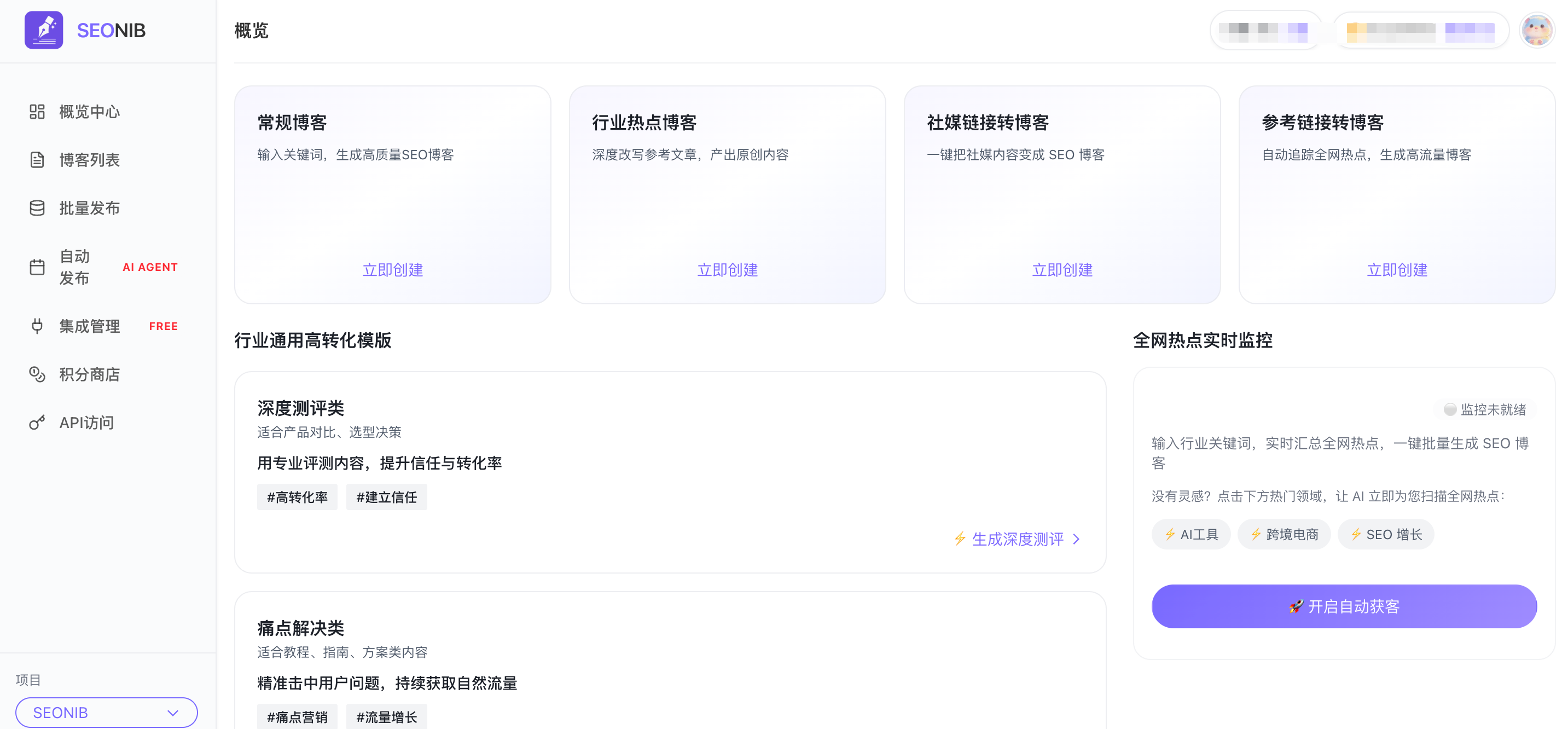
Speaking of which, I’d like to mention a tool our team introduced to tackle the persistent challenge of “continuous high-quality content production.” When our human resources are focused on core business development, but content update frequency and SEO friendliness must be guaranteed, we started using platforms like SEONIB. Its value isn’t in replacing our strategic thinking but in efficiently executing the content direction we set. For instance, we input core keywords and topic directions, set the target language (Chinese or English), and it can quickly generate SEO-structured blog posts and track certain industry trends, providing creative inspiration. This greatly frees up our operational manpower, allowing us to ensure the website has stable, regular content updates even in its early stages, and regular updates are the core driving force for attracting frequent crawler visits and accelerating indexing.
Step 4: Establishing Initial Off-Site Links A new website without external links is like an isolated island. We need to consciously build some “bridges” to this island.
- Social Media Pre-heating: After publishing new content, simultaneously share it on relevant social media channels (e.g., LinkedIn, Twitter, industry forums). Although social links themselves may have limited SEO weight, they can drive real traffic, and these user behaviors are positive signals.
- Leveraging Existing Assets: If you have other established, authoritative websites, blogs, or social media accounts, you can reasonably direct links from these to key pages on the new site.
- Partnerships and Industry Directories: Seek mentions or links on partner websites, relevant industry directories, or review sites. Quality is more important than quantity. Even a few links from relevant fields are excellent votes of trust.
Mindset Adjustment: Indexing is a Process, Not an Event
Finally, and most importantly, adjust your expectations. In 2026, getting the core pages of a new website indexed within a few days to two weeks is entirely achievable through the systematic methods described above. However, getting hundreds or thousands of pages, especially content pages, indexed quickly requires time, patience, and continuous investment.
Don’t expect miracles overnight. Quick indexing is the result of “earning” it through a series of correct, consistent actions, not a “setting” that works once and for all. It requires treating search engines as partners with whom you build relationships through value, rather than machines that can be manipulated at will.
When you shift your focus from “urging indexing” to “providing continuous value” and “establishing technical friendliness,” indexing issues often resolve themselves and lay a solid foundation for the long-term SEO health of your website.
FAQ
Q: How long after submitting a sitemap will it be indexed? A: There’s no fixed timeline. Search engines might discover and process a sitemap quickly (within hours), but the actual crawling and indexing of pages depend on your website’s overall trust signals. For new sites, it might take days to weeks. Systematic practices can significantly shorten this period.
Q: Does a new website need to publish a large volume of articles to speed up indexing? A: It’s not about “largeness” but “regularity” and “quality.” Consistently publishing 2-3 high-quality, original pieces of content weekly is far more effective than publishing 10 low-quality or plagiarized articles in one day. Regularity is more important than volume.
Q: I’ve submitted URLs and updated content, but indexing is still slow. What could be the reason? A: Common reasons include: 1) Website technical issues (e.g., robots.txt blocking, excessive JS blocking, slow server response); 2) Low content quality or high duplication with other sites; 3) The website has no external mentions or links, lacking trust signals; 4) The website domain has a problematic history (if an old domain is being reactivated). It’s recommended to start by checking technical aspects and content originality.
Q: Are paid rapid indexing services effective? A: Some paid services on the market claiming “rapid indexing” typically work by publishing content containing your links through their high-authority platforms (e.g., news sources, directories) to guide crawlers. This method might be effective, but its results are unstable and can carry risks (e.g., poor quality of link sources). In the long run, it’s better to invest in your own website’s content and technical development.
Q: For multilingual SaaS websites, how should different language versions be handled for indexing?
A: It’s essential to use correct multilingual SEO technical tags (like hreflang tags) and submit sitemaps for different language versions to search engines. Treat each language version as a separate “content library” for establishing update rhythms and acquiring links, avoiding competition between different language pages.