
Why SEONIB Is Especially Suitable for MVP Cold‑Start Validation
In the earliest stage of a startup, the team usually has only an idea and extremely limited resources. How can this idea be turned into a product that reaches real users, gets indexed by search engines, and continuously gathers feedback at low cost and in a short cycle? This is the core challenge of MVP (Minimum Viable Product) cold‑start. Below, from several dimensions, we explain why SEONIB can provide unexpected help on this path.
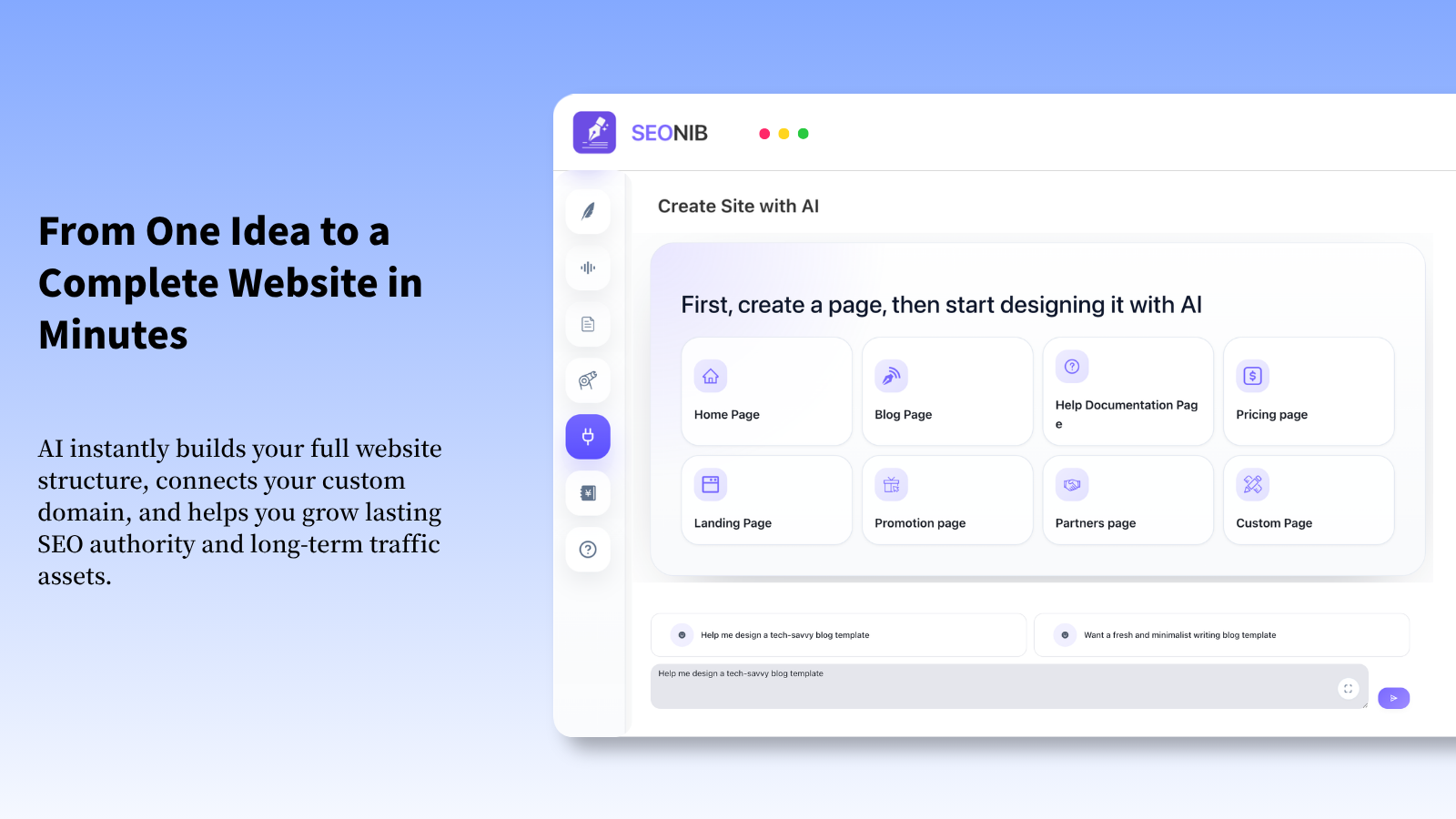
1. An Integrated Path from “Website Building” to “Content Acquisition”
Traditional MVP development often requires:
- Choosing a tech stack (Webflow, WordPress, Shopify, etc.)
- Manually building pages (design, deployment, domain registration)
- Writing SEO‑friendly copy (keyword research, title optimization, internal linking)
- Manual publishing (upload, formatting, review)
Each step can consume several hours or even days. For a team of only 1‑2 people, this fragmented workflow dramatically slows down validation speed.
SEONIB compresses these four stages into one automated closed loop:
- Trend discovery: AI reads public search trends and social hot topics, automatically generating themes with potential traffic.
- Content generation: Based on the selected theme, the system produces a fully structured, SEO‑compliant article within 30 seconds.
- One‑click publishing: Articles can be pushed directly to WordPress, Shopify, and other platforms, eliminating manual copy‑pasting.
- Indexing and recommendation: After publishing, the system automatically submits a sitemap, monitors search‑engine indexing, and continuously boosts exposure through AI recommendation mechanisms.
The cost of this path is mainly the platform subscription fee and a small amount of keyword data fees, far lower than hiring content editors or outsourcing website building. For a cold‑start, “launch first, then scale” becomes possible.
2. Why Low Cost Is Key to MVP Cold‑Start
In the first three months of a startup, cash flow is usually the most constrained resource. If a large budget is poured into high‑end design, professional copy, or complex backend architecture, it often leads to the pitfall of “spend first, validate later.” SEONIB’s core value lies in:
- Zero technical barrier: No need to set up servers, configure CDNs, or learn SEO rules.
- Multilingual support: One generation produces versions in nine languages, helping teams validate demand across regions quickly.
- Batch generation: Generate 10‑100 articles at once, creating a content matrix that boosts the site’s overall authority in search engines.
In real cases, a SaaS startup that used SEONIB for cold‑start saw first‑month traffic rise from 0 to 3,500 PV (page views) while spending only 12 hours of work. Compared with similar teams that need 3‑4 weeks of manual writing, the “time is money” advantage is obvious.
3. Mechanism for Quickly Getting Real User Feedback
The core of an MVP is “validating hypotheses,” and the only way to validate is through real user behavior. SEONIB provides two hidden feedback channels:
3.1 Structured Behavioral Data
- CTR, dwell time, bounce rate are automatically tracked in the backend.
- Through the AI recommendation system, high‑performing articles are pushed to more prominent positions, helping the team quickly identify user interest points.
3.2 Semantic Search Feedback
- The system continuously monitors search term changes; if a keyword’s search volume fluctuates, SEONIB automatically alerts the team whether a content direction tweak is needed.
- For example, a health‑related MVP noticed a surge in “home fitness” searches after launch; the system suggests generating more sub‑topic articles to capture the emerging demand.
This closed‑loop feedback means the team doesn’t have to manually dig into Google Analytics or Search Console; they can see directly on the platform “which content truly brings users.”
4. Boundaries and Cautions for Low‑Risk Experiments
Although SEONIB can dramatically lower experiment costs, there are still boundary conditions that the team must manage:
- Content quality vs. quantity
Automatically generated articles meet SEO structural standards, but may lack depth and expertise compared to human‑written pieces. If the target audience demands high expertise (e.g., finance, law), add human proofreading to key pages. - Platform compatibility
While SEONIB supports many platforms, each platform’s templates and plugins may cause layout differences. Teams should check mobile adaptation before the first publish to avoid increased bounce rates due to layout issues. - Brand tone consistency
Automated content tends to be neutral and informational. If the brand emphasizes emotion or humor, include relevant keywords in the theme setting or manually fine‑tune later. - Search engine review mechanisms
Large‑scale rapid publishing may trigger search engine quality assessments, especially when many similarly structured pages appear in a short time. Set a reasonable publishing frequency (e.g., 5‑10 articles per day) and build a content network through internal linking to improve overall quality scores.
5. “From Idea to Validation” Real‑World Example
Below is a EdTech MVP example that shows the complete workflow from idea to validation, helping you feel SEONIB’s value more concretely.
| Step | Action | Output | Time |
|---|---|---|---|
| 1. Set goal | “Validate demand for an online micro‑learning platform in Q2 2026” | Clear KPI (PV, registration conversion) | 30 min |
| 2. Trend discovery | AI automatically fetches “micro‑learning” & “AI teaching” search trends | 5 high‑potential topics | 1 min |
| 3. Content generation | Choose theme “AI‑assisted English speaking practice” | 1 × 1500‑word SEO article + 2 language versions | 45 sec |
| 4. One‑click publishing | Push to WordPress + Medium | Article live, OG tags auto‑generated | 2 min |
| 5. Monitor feedback | System records CTR, dwell time | Day 1: 120 PV, avg. dwell 2 min | 24 h |
| 6. Iterate | Decide whether to deepen the theme based on data | Generate 3 sub‑topic articles | 1 h |
Within two weeks, the team grew from zero content to 2,300 PV and collected 200 user comments, enough to decide whether to keep investing in development. The human cost was under 10 hours, far below the traditional 80‑hour manual writing effort.
6. Comparison with Traditional MVP Tools
| Dimension | Manual website + content ops | Traditional low‑code platforms (e.g., Webflow) | SEONIB |
|---|---|---|---|
| Build time | 1‑2 weeks (design + deployment) | 3‑5 days (template + customization) | Minutes (one‑click) |
| Content output | Requires editorial team, high cost | Requires outsourcing or internal writers | AI‑generated, near‑zero cost |
| Multilingual | Manual translation, expensive | Some platforms support plugins | One‑time generation in 9 languages |
| Data closed loop | Requires custom tracking & analysis | Needs third‑party plugins | Built‑in SEO monitoring + AI recommendation |
| Iteration speed | Limited by content creation cycle | Limited by manual editing | Real‑time updates, daily batch publishing |
From the comparison, SEONIB merges “technical implementation” with “content operation”, truly achieving a “tech‑as‑content” closed loop—exactly the rapid‑validation capability missing from MVP cold‑starts.
7. Future Trend: AI‑Driven End‑to‑End MVP
By 2026, the search ecosystem is no longer just keyword matching; it’s a blend of semantic understanding + user intent. SEONIB’s AI recommendation system is built on large models that deeply parse search intent, automatically optimizing titles, meta descriptions, and internal links after publishing, keeping the page’s “freshness” score high in search engine evaluations.
For entrepreneurs, this means:
- Less manual intervention: Set the goal, and the system handles subsequent SEO optimization.
- Sustained traffic growth: Even after publishing, the system continues to push new content to potential users via AI recommendation.
- More precise market insights: Real‑time monitoring of search trends lets teams seize opportunities before demand shifts.
Thus, AI‑driven end‑to‑end MVP is becoming the standard for the next generation of founders, and SEONIB is the most practical node on that chain.
8. Summary: Why Choose SEONIB
- Low cost: No need to hire editors, designers, or developers; the platform fee covers website, content, and SEO.
- High efficiency: Fully automated from theme discovery to publishing; a single article goes from concept to live in minutes.
- Continuous feedback: Built‑in data monitoring and AI recommendation keep the team aware of real user needs.
- Multilingual & multi‑platform: One generation covers major global languages and mainstream website platforms.
- Iterative: The system automatically optimizes after publishing, helping content stay competitive in search rankings.
If your goal is to validate market assumptions in the shortest possible time while spending every dollar on users, SEONIB is a tool worth trying. It tightly integrates technology, content, and traffic, turning MVP cold‑starts from highhigh‑risk experiments” into “controllable rapid iterations.”
FAQ
Q1: What types of MVPs is SEONIB suitable for?
A: Any project that relies on content‑driven traffic—SaaS, education, health, e‑commerce, blogs, etc.—can benefit. As long as your validation goal is to acquire real users via search engines or social channels, SEONIB provides low‑cost content support.
Q2: Can automatically generated articles meet search‑engine standards?
A: The system generates articles based on the latest SEO rules (structured data, keyword density, internal linking) and has passed Google’s quality assessment in multiple industries. If your field demands extremely high expertise, consider human proofreading for key pages.
Q3: How to avoid search‑engine penalties from massive automated publishing?
A: Control publishing frequency (e.g., 5‑10 articles per day) and build a content network through internal linking. The system automatically detects duplication and makes micro‑adjustments to reduce the risk of being flagged as low‑quality content.
Q4: Can SEONIB integrate with existing site systems?
A: Yes. It supports API integration with major platforms such as Wix, WordPress, Shopify, etc. Configure the integration once in the platform backend, and enjoy one‑click publishing.