
From Zero to One Hundred: When I Stopped Manual Writing and Let AI Take Over My Blog Content
I once believed that good blog content had to go through a long and painful process of ideation, drafting, revising, and optimizing. My team, whether running cross‑border e‑commerce independent sites or global content marketing, spent most of its time on the “production” stage. We researched keywords, analyzed competitors, and strained our brains to make each article both SEO‑friendly and readable. Until I realized we had fallen into a massive efficiency trap—we spent 90 % of our time “manufacturing” content and only 10 % thinking about strategy and results.
The turning point of this realization came late one night. Staring at a cluttered content calendar and the team’s exhausted feedback, I realized we had to change. What we needed wasn’t a faster writer, but a system that could run automatically. That’s when I discovered SEONIB.
Behind One‑Click Generation: Liberation, Not Replacement
At first, like many others, I was skeptical of “one‑click generation of high‑quality content.” High quality? Can AI‑written articles really look good? Can they rank? This skepticism is healthy because it pushes me to verify rather than follow blindly.
My approach was to start with the area that gave me the most headaches: product description pages. Our cross‑border e‑commerce sites have hundreds of SKUs, and writing a unique, optimized description for each product is a nightmare. I compiled an Excel sheet containing core product keywords, features, and “real problems” extracted from customer reviews. I imported this sheet into SEONIB.
Click generate. Then I got the first batch of articles.
The result was unexpected. The articles had clear structures, included the selling points we provided, and naturally incorporated SEO elements. More importantly, they didn’t produce hollow “marketing buzzwords” but built content around the “real problems” we input. This made me realize that SEONIB’s “high quality” isn’t conjured out of thin air; it heavily depends on the quality of the “material” you feed it. Feed it ore, and it can forge steel. Give it only a few words, and it can only cobble together generic fluff.
The Truth About Saving Time and Effort: Where Is the Time Spent?
After using SEONIB, our team’s work underwent a fundamental shift. The biggest savings weren’t in “writing time” but in “context‑switching time” and “decision‑paralysis time.”
In the past, a content specialist’s day might look like this: opening ten web pages to research keywords, switching between several tools to check difficulty and volume, brainstorming outlines, writing, checking SEO scores, revising… the whole process was riddled with interruptions.
Now, our process has become: a weekly “material input” meeting. We discuss the next phase’s target markets, product lines, and real user questions gathered from customer service and social media. Then we organize these into structured information sources—perhaps a keyword list, a “question‑answer” pair table, or a topic matrix. The rest is handed over to the system for automatic execution.
Effort saved is the repetitive tool operation, agonizing over wording, and the “mental energy” consumed by writing itself. Time saved is the most time‑intensive step: deciding what to write and producing the first draft. The team’s time is freed up for higher‑value work: analyzing content performance, brainstorming strategies, engaging with users, and optimizing conversion paths.
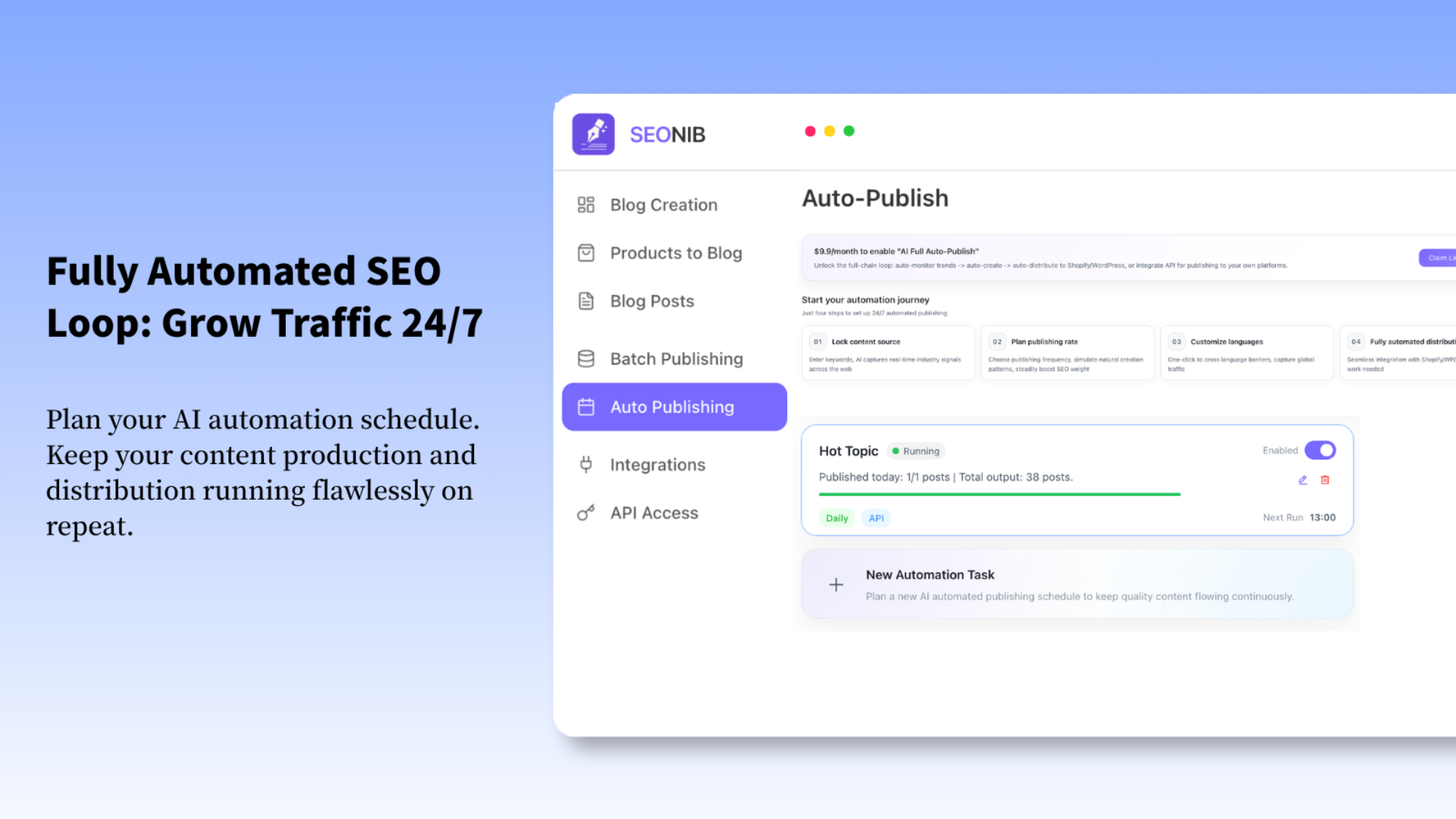
The “Invisible Lever” for Cross‑Border E‑Commerce and Content Marketing Teams
For cross‑border e‑commerce teams, content has two core goals: acquiring search traffic and driving conversions. Traditionally, this required close collaboration between SEO experts and copywriters, which is costly.
SEONIB acts as an “execution amplifier” here. When we launch a new product, we can quickly generate blog posts, buying guides, and FAQs covering various long‑tail keywords. These pieces are not isolated; they together build a content matrix that intercepts user search intent from multiple angles. I’ve observed that very specific product‑usage scenario articles (e.g., “How to combine product A with product B to solve X problem”), despite low search volume, have extremely high conversion rates because they precisely match users’ needs at the final stage of purchase decisions.
For global content marketing teams, multilingualism is a huge challenge. Manual translation is not only costly but also prone to losing original meaning and local context. SEONIB’s multilingual generation isn’t about “translation” but about “localized content creation.” You can organize core material and key points in Chinese, then click a button to generate English, Japanese, Spanish, and other language versions. This ensures consistency of core information and SEO foundation across global sites; local teams only need to perform final polishing and cultural adaptation, resulting in an order‑of‑magnitude efficiency boost.
Unexpected Gains and Essential Cautions
Automated content generation isn’t flawless. In practice, I’ve distilled several key points:
The quality of the “material” sets the ceiling. AI cannot create information beyond what you know. The more specific and close to real user scenarios your input material is, the more competitive the generated content becomes. We began systematically collecting high‑frequency terms from customer chat logs and product reviews, which became our most valuable generation material.
Generation is not the end, but the beginning. I never publish a one‑click‑generated article directly. It’s an excellent draft, but it needs human “soul” injection—perhaps a unique industry insight, a real data case, or a brand‑specific tone. Relying entirely on AI leads to homogenized content.
Traffic growth is gradual and cumulative. Don’t expect a viral surge the day after publishing. This is a long‑term battle. SEONIB’s value lies in its ability to “continuously, stably, and in bulk” produce content with basic SEO quality. Over time, indexed page counts steadily rise, and long‑tail traffic converges like streams forming a river, delivering substantial stable visitors. Our technical blog, after three months of automated operation, saw a 300 % increase in daily organic traffic, primarily from hundreds of long‑tail articles covering various technical issues.
Focus on “indexing” and “recommendation”. After publishing, whether content is quickly indexed by search engines and enters their AI recommendation systems (e.g., Google’s “related searches,” “People also ask”) is key to sustained traffic. Using SEONIB’s automatic publishing and monitoring features, we found that clearly structured, Q&A‑rich content is more likely to be indexed and recommended, yielding secondary or multiple traffic exposures.
Final Thoughts: From Content Creator to Content Curator
The biggest mindset shift when using tools like SEONIB is moving from being a “content creator” to a “content curator” and “system architect.”
I no longer write every line myself, but I need to define the strategic direction of content, select and provide the highest‑quality “raw material,” design the cadence and matrix of content publishing, and continuously analyze data to optimize the whole system. My role has become more strategic.
One‑click generation of high‑quality blog content sounds like a technical feature, but fundamentally it’s a workflow revolution. It forces you to ask: what is the core value of your content? Is it flamboyant prose, or the density of information that solves problems? When machines take over basic information organization and expression, we humans can focus more on creating irreplaceable insights, emotional connections, and strategic judgments.
This path is not about replacement but about elevation.
FAQ
Q: What types of blogs is this suitable for? Does it work for product blogs and thought‑leadership blogs?
A: The focus differs. For product blogs, tutorial blogs, FAQs, and news‑type blogs based on keyword research, automated generation is extremely efficient and can quickly cover a large number of long‑tail queries. For thought‑leadership blogs that require deep industry insight, unique viewpoints, and a strong personal brand voice, AI‑generated content works best as a draft or material‑gathering tool, while core ideas and in‑depth analysis still need human leadership. The two can be combined: use automated content to build a traffic foundation and drive traffic to deeper pieces.
Q: How can we ensure the content isn’t repetitive and remains unique?
A: Uniqueness comes from the “exclusive material” you input. Don’t just feed a few generic keywords. Provide your product’s unique data, real user feedback, internal case studies, and under‑discussed use cases. AI will organize based on these distinctive inputs, naturally producing differentiated content. Adding your own commentary and analysis after generation is also an effective way to boost uniqueness.
Q: How effective is the multilingual content? Can it reach native‑speaker level?
A: For native‑level publishing, some human polishing may still be required, especially for cultural references and idiomatic expressions. However, the generated multilingual content is already very reliable in grammatical accuracy, information completeness, and basic SEO structure. For teams that need to quickly cover multiple markets and build foundational content assets, it can save more than 90 % of translation and draft‑writing time; local teams only need to perform final optimization, offering an excellent cost‑benefit ratio.
Q: How long does it usually take from starting to use it to seeing noticeable traffic growth?
A: It depends on your content base, industry competition, and publishing frequency. Based on our experience, if you maintain a steady publishing cadence (e.g., 1–2 articles per day), you’ll typically start seeing stable traffic from long‑tail keywords after 1–2 months. After 3–6 months, as the number of indexed pages accumulates, overall organic traffic will show a clear step‑wise increase. This is a gradual process that follows SEO principles and requires patience and consistent execution.